
Businesses everywhere turn to SaaS (Software as a Service) to make their operations smoother and faster. Companies deliver software through the internet, so users access powerful tools without downloading or installing anything on their own devices.
This approach saves money on hardware, speeds up setup, and lets teams scale up easily as they grow. Consider Shopify, for instance: entrepreneurs use it to launch online stores in hours, skipping the hassle of building everything from the ground up.
Today, millions of SaaS companies thrive online, and their influence keeps expanding across industries. If you run a business or plan to start one, diving into SaaS statistics for 2025 gives you a clear picture of the market’s size, explosive growth, and emerging trends.
These insights help you spot opportunities, choose the right tools, and apply SaaS to cut costs, boost productivity, and drive profits.
In this detailed guide, you explore key numbers, practical tips for adoption, and fresh discussions from Quora and Reddit, where users share real-world questions about AI integrations, startup hurdles, and subscription fatigue.
Whether you’re a small business owner testing the waters or a manager optimizing your tech stack, these stats show how SaaS turns challenges into advantages.
Key SaaS Statistics
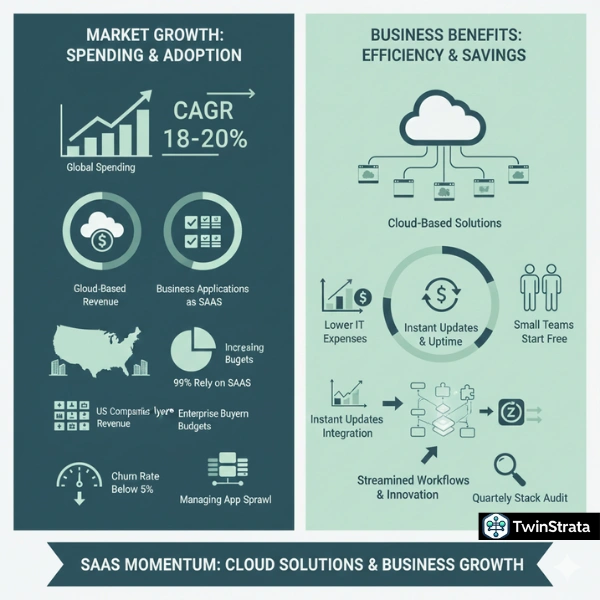
The SaaS world buzzes with momentum in 2025. Experts forecast global spending on SaaS to climb to $295.08 billion this year, a sharp jump from $247.2 billion in 2024.
This surge comes from a compound annual growth rate (CAGR) of 18-20%, as businesses prioritize cloud-based solutions for their agility. By 2025, 85% of all business applications operate as SaaS, proving how leaders ditch old-school software for flexible options that adapt to change.
In the United States, roughly 12,400 SaaS companies lead the charge, generating over $221 billion in revenue. A whopping 86% of enterprise buyers plan to raise or hold steady on their SaaS budgets, recognizing the value in tools that scale without breaking the bank.
Nearly every company—99%—relies on at least one SaaS app, underscoring the shift to widespread cloud use.
Churn rates hover at 5-7% yearly across sectors, but top performers keep it below 5% by listening closely to users and tweaking features. On average, organizations juggle 106-112 SaaS apps, a slight dip from recent highs as teams consolidate to avoid overload, yet this still highlights deep dependence on digital tools.
For your business, these figures spell opportunity. You lower IT expenses by 30-50% with SaaS, gain instant updates without downtime, and connect apps seamlessly to streamline workflows.
Small teams start with free tiers to experiment, while larger ones audit their stack quarterly to trim waste. On Quora, users ask about balancing app sprawl with efficiency—many recommend tools like Zapier for integrations, saving hours weekly.
Reddit threads echo this, with founders sharing how switching to SaaS cut their setup time from weeks to days, freeing focus for customer growth.
Also read about: Marketing Automation Statistics
SaaS Market Size and Growth Statistics
Companies flock to SaaS because it simplifies complex tasks and sharpens focus on core goals. In 2024, the global market reaches $317.55 billion, with bold projections aiming for $1,228.87 billion by 2032.
Growth powers forward at a 18.4% CAGR starting from 2023, fueled by demand for remote-friendly tech. Over the past seven years, the industry swells by about 500%, a testament to its resilience even through economic dips.
Businesses shell out around $92.19 per employee on SaaS in 2024, though totals range from $1,000 to $3,500 yearly based on team size and needs.
The US claims the top spot, eyeing $221.50 billion in 2025 revenue alone. Public cloud investments balloon from 17% of IT budgets in 2021 to more than 45% by 2026, pouring fuel into SaaS expansion.
Small businesses benefit hugely here: you begin with low-cost apps for essentials like email marketing or inventory tracking, then scale without massive upfront spends.
Larger firms use these stats to justify budgets, showing ROI through faster deployments and data insights. Check this table for a year-by-year view of market size from 2020 to 2025, including forecasts:
| Year | Market Size (USD Billion) | Growth Rate (%) |
| 2020 | 178 | 13.4 |
| 2021 | 197 | 10.7 |
| 2022 | 217 | 10.2 |
| 2023 | 273.55 | 26.1 |
| 2024 | 317.55 | 16.1 |
| 2025 | 295.08 | 20 |
This steady climb reveals acceleration post-pandemic. Yet, Quora users point out a wrinkle: early 2025 brings cautious spending in B2B due to inflation, with some sectors pausing expansions.
Reddit discussions counter this optimism with AI’s role—startups report 25% faster growth by embedding AI early, advising niches like healthcare analytics over broad tools.
You apply this by benchmarking your growth: track SaaS ROI with simple dashboards, aiming for 20% efficiency gains to stay competitive.
Also read about: Conversion Rate Optimization Statistics
SaaS Adoption Statistics

Industries worldwide snap up SaaS to weave it into daily operations, creating seamless ecosystems. More than 80% of companies depend on at least one SaaS app, and that figure hits 95% for organizations overall in recent years.
Small businesses lead with 78% adoption, drawn to easy onboarding. Healthcare surges at 20% yearly, using SaaS for secure patient records and telehealth.
Mega-firms with over 10,000 staff average 447 apps, but smarter consolidation drops it to 158 for those above 5,000 employees. Retail and e-commerce boom at a 23.6% CAGR, targeting $138.9 billion by 2027, while banking and finance (BFSI) chase $130.7 billion at 19.2%.
You kickstart adoption by identifying pain points—say, manual invoicing—and testing SaaS like QuickBooks for automation.
Teams train quickly, often in under a week, yielding immediate wins like 40% faster reporting.
Here’s a clear breakdown of average SaaS apps by company size:
| Company Size (Employees) | Average SaaS Apps |
| 1-199 | 42 |
| 200-749 | 103 |
| 750-1,499 | 86 |
| 1,500-4,999 | 142 |
| 5,000+ | 158 |
This spread shows how scale drives variety. On Reddit’s r/SaaS subreddit, users rave about low-code platforms like Bubble, which let non-coders build custom apps, slashing dev costs by 70%.
Quora threads reveal 95% of leaders plan AI-enhanced adoption by year-end, asking how to upskill teams—answers stress free tutorials and pilot programs.
Benefit by piloting two apps quarterly: measure uptake with user surveys to refine choices and avoid silos.
Also read about: Webinar Statistics
SaaS Usage Statistics
Workers leverage SaaS daily to sharpen efficiency and delight customers. 80% of businesses run at least one app, and 70% of chief information officers (CIOs) pick SaaS for its bend-and-stretch qualities.
By late 2024, 99% of companies embrace at least one solution, evolving to 85% SaaS-based apps by 2025. Usage skyrockets from 80 apps per organization in 2020 to 130 in 2022, now settling at 106-112 as leaders prune redundancies.
SaaS claims over 50% of the software pie and 36.6% of cloud services, making it the go-to backbone.
In practice, you deploy SaaS for everything from CRM like HubSpot to track leads to analytics tools like Google Analytics for real-time insights. This setup trims errors by 25% and speeds decisions.
Forums light up with usage tips: Reddit users in r/Entrepreneur discuss 71% of firms betting big on AI-powered SaaS, automating rote tasks like data entry to reclaim 10 hours weekly per employee.
Quora questions focus on onboarding metrics—users want activation rates above 60%—and share hacks like personalized demos to hit that mark.
Harness this by mapping your workflows: integrate SaaS for hybrid teams via Slack or Microsoft Teams, fostering collaboration that boosts output by 15-20%.
SaaS Customer Retention and Churn Statistics
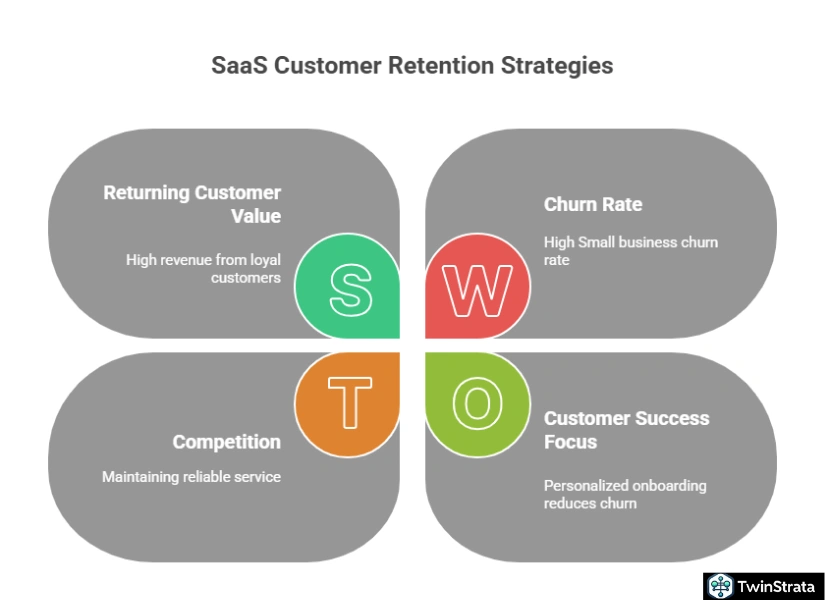
SaaS success hinges on sticky customers who stick around. Top companies target 3-5% annual churn for small-business focus, with B2B monthly rates at 3.5% in 2025.
Loyal users deliver 65% of revenue and splurge 67% more than newcomers. Holding onto customers costs five times less than hunting new ones, and bumping retention by 5% can swell profits 25-95%. Providers win by rolling out tailored updates and proactive support.
You build retention by selecting SaaS with intuitive interfaces and feedback portals—tools like Intercom shine here. Track net promoter scores (NPS) monthly to spot at-risk users early.
Reddit’s r/startups warns of subscription overload, where users juggle 10+ tools and cancel impulsively; solutions include bundled pricing to simplify.
Quora dives deeper, noting 90% of SaaS flops trace to mismatched marketing, not weak products—users urge aligning features to real pains like mobile access. Apply these by nurturing relationships: send quarterly value recaps to show ROI, turning one-time users into advocates.
SaaS Pricing Model Statistics
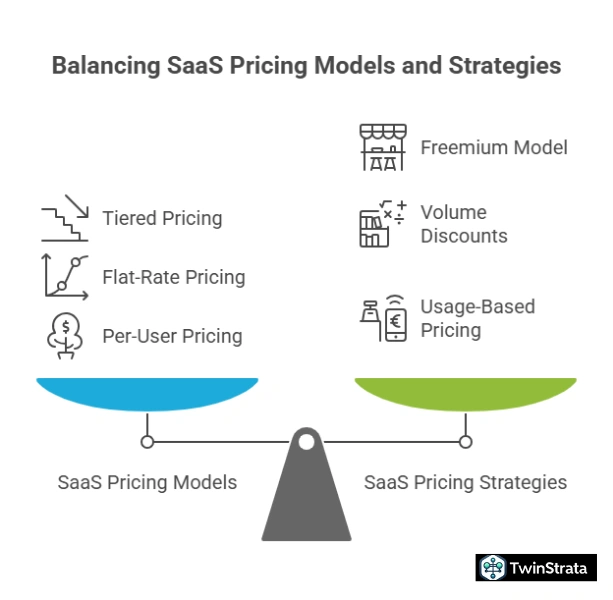
SaaS flexes with models like tiered (scale by features), flat-rate (predictable bills), per-user (simple scaling), and usage-based (pay for what you consume). Per-user reigns supreme for its straightforward appeal and low barriers.
Yet, prices inflate 8.7%, nudging subscriptions nearly 9% higher year-over-year. A striking 94% of B2B SaaS heads tweak pricing and packages annually, with 40% refreshing quarterly to match market shifts. Just 10% stick to cost-plus, adding markups to expenses.
Pick wisely: startups favor freemium to hook users, while enterprises negotiate volume discounts. This keeps bills aligned with value. Quora users push product-led growth (PLG), where free tiers convert 20-30% to paid via self-serve upgrades.
Reddit rants about fatigue from endless subs, suggesting hybrid models with credits for unused time. You optimize by auditing spends: switch to usage-based for variable needs, saving 15-20% on idle features.
SaaS Security and Compliance Statistics
As usage soars, so do risks—55% of organizations hit a SaaS security snag in the last two years, and 58% monitor 50% or fewer apps, with 7% blind entirely. Breaches affect 31%, a 5% creep from last year.
A concerning 38% fret over GenAI data leaks and IP theft, prompting 15% to consolidate security under cyber teams. Providers ramp up with encryption and zero-trust models.
You safeguard by vetting vendors for SOC 2 compliance and multi-factor auth. This builds trust and dodges fines. On Quora, threads probe AI’s double edge—threat detection tools flag 80% more anomalies, but users ask for vendor audits.
Reddit shares breach recovery stories, stressing backups. Prioritize: run annual security drills with your SaaS stack to minimize downtime.
Regional SaaS Market Statistics
SaaS blooms unevenly by region, with the US at the forefront via 12,400 companies and 46% global share. North America clocks $131.18 billion in 2023 value.
Europe eyes Germany as its powerhouse, while Asia-Pacific crowns China, trailed by Japan and India.
| Country | No. of SaaS Companies |
| United States | 12,400 |
| United Kingdom | 1,700 |
| Canada | 1,100 |
| Germany | 916 |
| India | 1,100 |
You expand globally by choosing multi-region SaaS for latency-free access. Quora notes India’s 30% CAGR in edtech SaaS, inspiring cross-border pilots.
SaaS Marketing and Sales Statistics
SaaS sales stretch to 69 days on average, up slightly as buyers deliberate. Firms dedicate 15% of budgets to marketing, but discounts erode 18% of deal value.
Power players wield email (84%), social ads (75%), and content (69%). Blogs lure 67% more leads, and 47% of prospects digest 3-5 pieces before chatting sales.
You amplify reach with content calendars—post case studies weekly. Quora touts AI for personalized campaigns, lifting conversions 25%. Reddit advises subreddit AMAs for authentic buzz.
SaaS Startup Funding Statistics
Investors pour cash into SaaS: US firms snag $17.4 billion in 2023 VC, $4.7 billion early 2024.
Globally, SaaS snags 47% of funding, up from 36% in 2019; H1 2024 totals $72.3 billion.
Early-stage hits $10.3 billion, enterprise $21.9 billion in Q2. AI claims 68% of 2025 pots.
| Year | VC Investment (Billion USD) |
| 2020 | 118.7 |
| 2021 | 276.9 |
| 2022 | 209.3 |
| 2023 | 186.8 |
| 2024 (H1) | 72.3 |
SaaS Industry Trends
AI/ML supercharges SaaS, with 71% investing and 95% adopting by 2025. Remote models spike collab tools.
Low/no-code democratizes building, cyber defenses harden. Vertical and micro-SaaS with AI agents rise. Reddit predicts agentic AI; Quora, dynamic pricing.
You ride waves by piloting AI for personalization, gaining 20% engagement lifts.
FAQs About SaaS Statistics
1. What makes SaaS so beneficial for small businesses in 2025?
Small businesses find SaaS beneficial because it delivers affordable, scalable tools that eliminate hefty upfront costs, enable rapid deployment without IT experts, and provide automatic updates to keep teams competitive in fast-changing markets.
2. How does AI change the game for SaaS adoption this year?
AI changes the game for SaaS adoption by embedding smart automation into everyday tools, offering personalized recommendations that boost user satisfaction, and strengthening security features, which leads 95% of organizations to integrate AI-powered apps for sharper insights and efficiency.
3. What churn rate should SaaS companies target in 2025?
SaaS companies should target a churn rate below 5% annually by implementing regular customer check-ins, customizing features based on feedback, and offering flexible support options that make users feel valued and reduce the likelihood of cancellations.
4. Why does so much funding flow to AI-focused SaaS startups?
So much funding flows to AI-focused SaaS startups because these ventures promise groundbreaking innovations like predictive analytics and automated workflows, which attract investors betting on explosive growth in a market where AI integrations can multiply user value and revenue streams quickly.
5. How can businesses get the most from their SaaS spending?
Businesses get the most from their SaaS spending by conducting quarterly audits to cut redundant apps, negotiating tiered pricing that matches actual usage, and adopting centralized dashboards for oversight, which together can trim expenses by 20-30% while maximizing productivity.
Also Read:
- Google Ads Statistics
- Online Advertising Statistics
- Content Marketing Statistics
- Live Streaming Statistics
- Digital PR Statistics
Conclusion
SaaS shifts yearly with fresh data and innovations, but it anchors 99% of businesses for peak performance.
AI and low-code integrations cement its must-have status.
Use these SaaS statistics for 2025 to select tools that slash costs and spark growth—dive into forums for user-tested gems.