
In a moment that could signal a dramatic turning point for Meta’s long and expensive quest to compete at the frontier of artificial intelligence, the company’s Chief AI Officer Alexandr Wang delivered a quietly bombshell announcement to employees during an internal town hall on July 2, 2026. Meta’s next flagship AI model — codenamed “Watermelon” — has matched the performance of OpenAI’s GPT-5.5 on closely watched AI benchmarks.
The disclosure, first reported by Business Insider citing two sources familiar with the matter, has sent ripples across the AI industry, marking the most credible sign yet that Meta’s $125–$145 billion infrastructure investment and aggressive talent acquisition drive are beginning to bear real fruit — even as significant challenges remain on the road ahead.
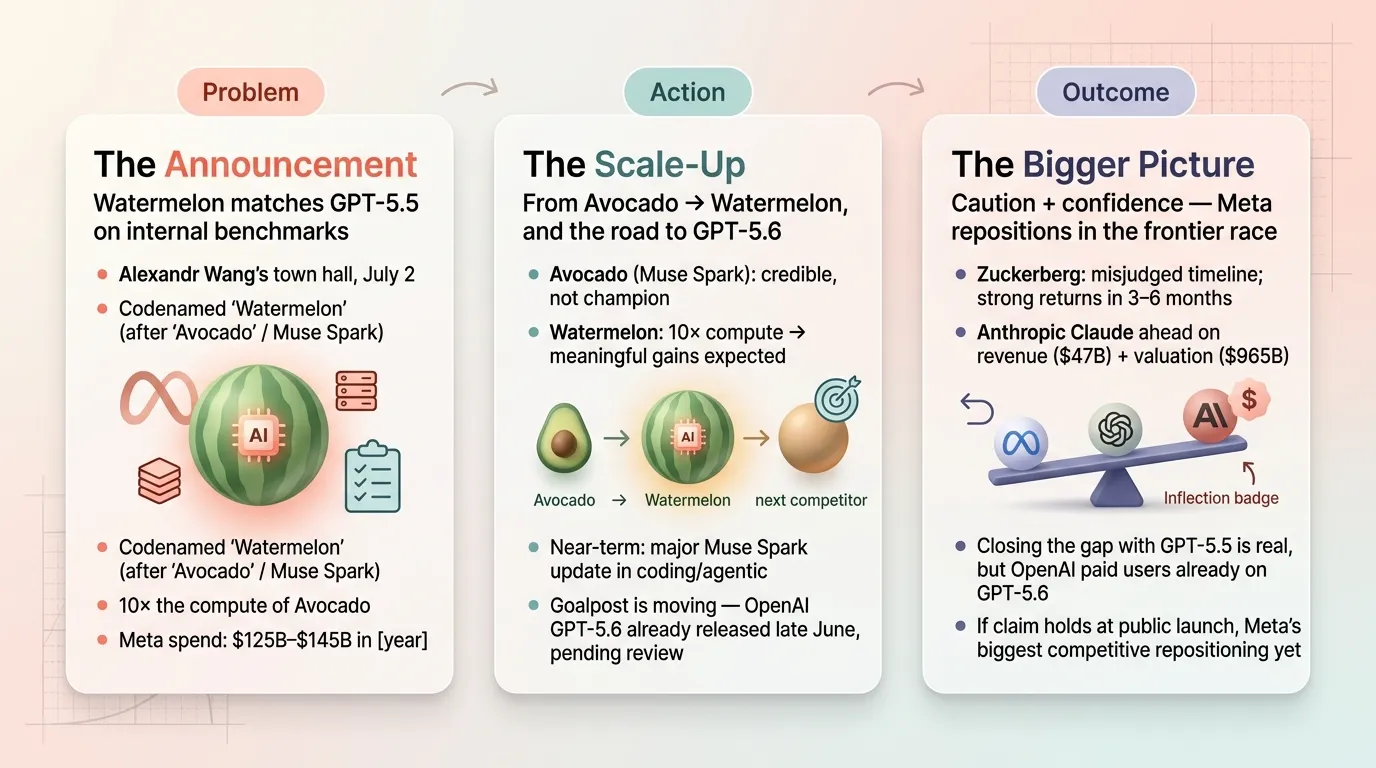
Wang’s revelation was precise but carefully bounded. “Watermelon, our next model after Avocado, is currently in training,” he reportedly told employees. “Watermelon uses an order of magnitude more compute than Avocado.”
The claim that Watermelon has reached GPT-5.5-level performance was based on internal benchmark results, though Wang notably declined to specify which benchmarks were cited or to release evaluation data publicly.
Meta itself declined to comment on the report when approached, and OpenAI did not respond to a request for comment. The opacity is deliberate — in the hypercompetitive AI race of 2026, even a carefully crafted internal town hall statement can shift market perceptions overnight.
From Avocado to Watermelon: Understanding Meta’s AI Model Lineage
To appreciate the significance of the Watermelon announcement, it helps to understand where Meta has come from. Earlier this year in April 2026, Meta released Muse Spark — the public name for its internally codenamed “Avocado” model — as the company’s first flagship large language model under Wang’s leadership of Meta Superintelligence Labs.
Muse Spark performed respectably on benchmarks and represented a genuine step forward for Meta, but analysts and developers broadly concluded that it did not match or exceed the capabilities of frontier models from OpenAI or Anthropic. It was a credible contender, not yet a champion.
Watermelon represents the next generation — and the scale-up is staggering. Wang confirmed that Watermelon is being trained using approximately 10 times more computing power than Avocado, a scale increase that in the current era of AI development typically translates directly into meaningful capability gains.
The compute involved reflects Meta’s expanded infrastructure ambitions: the company told investors it expects to spend between $125 billion and $145 billion in 2026 alone on chips, data centres, and related infrastructure — a figure that has already been revised upward from an earlier forecast of $115–$135 billion due to rising component costs and additional data centre construction.
Wang also used the town hall to signal near-term product improvements, posting publicly on X the same day that a significant update to the current Muse Spark model is coming soon, with major gains in coding and agentic capabilities designed to close the gap with rival models. When a user asked on X when Meta would have a coding model on par with Anthropic’s Claude Opus, Wang replied with characteristic Silicon Valley confidence: “Pretty soon — you’ll like what we have cooking.”
For a clear explainer on what the Watermelon model means for the broader AI landscape, this video is worth watching: 📺 Watch: What Is Meta’s ‘Watermelon’ Model?
The Bigger Picture: Zuckerberg’s AI Ambitions Meet Reality
The Watermelon benchmark claim arrives in a context that is anything but straightforwardly triumphant for Meta. Just days before Wang’s town hall, CEO Mark Zuckerberg delivered his own internal address to employees — one with a markedly more cautious tone.
Zuckerberg acknowledged that Meta had underestimated the time and complexity required for its AI reorganisation, and that company executives had miscalculated how quickly structural changes in the organisation would translate into visible improvements in AI agent technology. He added that Meta expects to see stronger returns from its AI investments over the next three to six months as newer models are launched — a timeline that implicitly places Watermelon at the centre of the company’s turnaround narrative.
This tension between Wang’s optimism and Zuckerberg’s caution reflects a broader reality: the AI race has entered a phase where raw benchmark performance, while necessary, is no longer sufficient to win market confidence.
OpenAI has already moved beyond GPT-5.5, having released its most powerful model yet — GPT-5.6 — in late June 2026, though that model has not yet been made generally available, pending US government security review requests. That means by the time Watermelon is fully trained and deployed publicly, Meta will need to have improved further still just to be level with what OpenAI’s paying customers will actually have access to.
Meta is also acutely aware that it is not just racing against OpenAI. Anthropic’s Claude has emerged as the surprise frontrunner in the AI industry, having surpassed OpenAI in both revenue run rate ($47 billion vs. $30 billion) and valuation ($965 billion vs. $852 billion) as of May 2026. Closing the gap with GPT-5.5 is a meaningful milestone — but the goalpost, as always in this industry, is moving fast.
Still, if Wang’s assessment proves accurate when Watermelon eventually ships publicly, it would represent the most significant competitive repositioning Meta has achieved since it first entered the frontier AI race. For Mark Zuckerberg, a man who has staked enormous personal and corporate capital on winning this battle, a model called Watermelon may turn out to be sweeter than it sounds. 🍉🤖
Quick Links: