
CFI

- Teaches practical financial skills
- Focus on real-world finance tools
- Flexible online learning
- Recognized by finance professionals
CFA

- Globally respected qualification
- Focuses on investment management
- Demands extensive exam prep
- Offers strong career prospects
FRM

- Specializes in risk management
- Recognized in banking and finance
- Covers market and credit risks
- Builds skills for managing financial risks
The finance industry continues to demand professionals with specialized skills and recognized credentials. In 2026, earning the right certification can significantly boost your career prospects, increase your earning potential, and open doors to senior positions in finance and banking.
After researching the current landscape and analyzing cost-effectiveness, career impact, and industry recognition, I have identified the seven best finance certifications for 2026.
Each certification serves different career paths, but all provide substantial value for finance professionals.
7 Best Finance Certifications In 2026
1. CFI Certifications (Corporate Finance Institute)
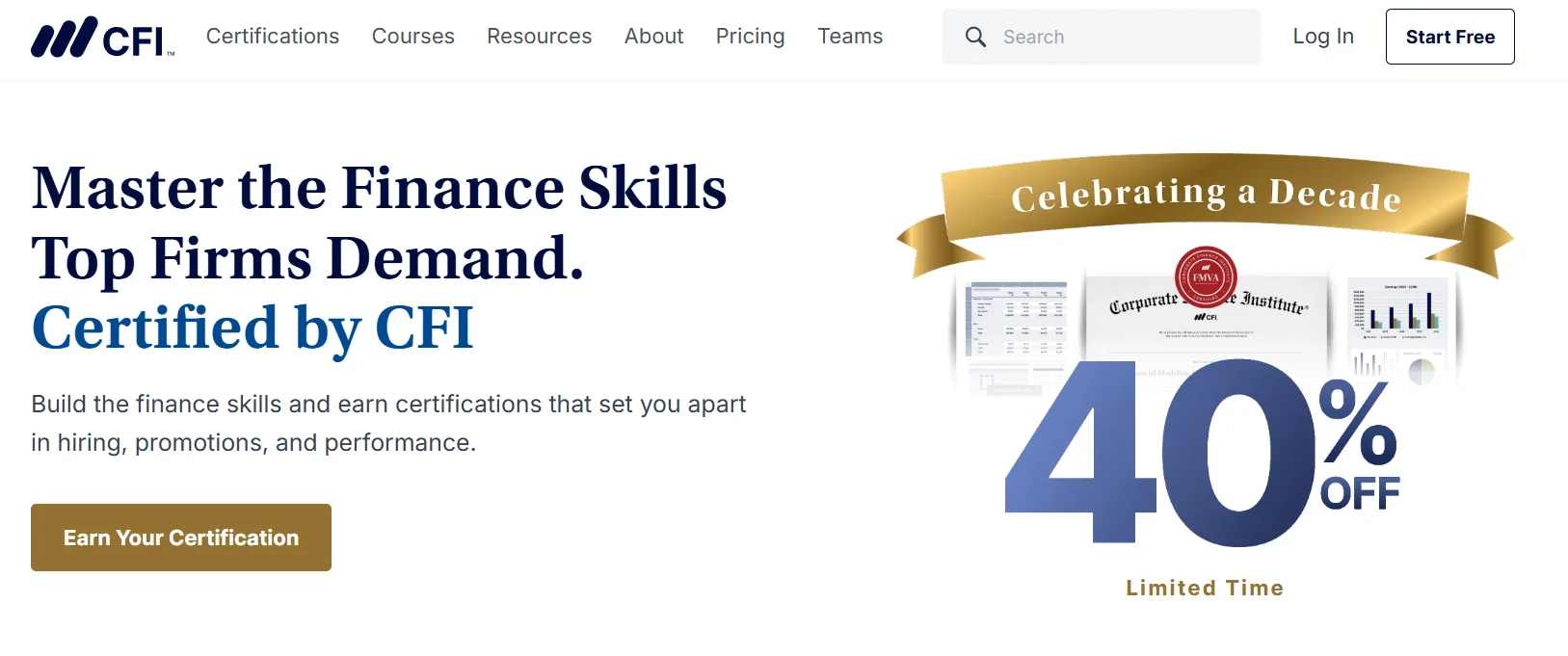
Best For: Finance professionals seeking practical, job-ready skills in financial modeling, analysis, and corporate finance
Overview
CFI has emerged as the leading online platform for practical finance education, serving over 2.8 million professionals across 190 countries. Unlike traditional academic programs, CFI focuses exclusively on teaching the exact skills that finance professionals use daily in their work.
Available Certifications
CFI offers seven specialized certifications, each targeting specific finance careers:
- FMVA (Financial Modeling & Valuation Analyst): Investment banking, corporate finance, equity research
- FPAP (Financial Planning & Analysis Professional): FP&A roles, corporate finance
- CBCA (Commercial Banking & Credit Analyst): Commercial banking, credit analysis
- CMSA (Capital Markets & Securities Analyst): Asset management, trading
- BIDA (Business Intelligence & Data Analyst): Data analysis, business intelligence
- FPWMP (Financial Planning & Wealth Management Professional): Wealth management, financial planning
- FTIP (FinTech Industry Professional): FinTech, digital banking
Cost Structure
- Self-Study Plan: $497 per year (currently $298.20 with 40% discount)
- Full-Immersion Plan: $847 per year (currently $508.20 with 40% discount)
- Student Plans: 50% discount (as low as $248.50 per year)
- Access: Unlimited access to all 7 certifications plus 250+ courses
Time to Complete
- Individual certifications: 3-6 months
- Study commitment: 8-10 hours per week
- All programs are self-paced
Why CFI Ranks #1
Unmatched Value for Money:
- At $298-$508 per year, you get access to all 7 certifications
- Compare to CFA ($3,520-$4,600) or MBA programs ($50,000-$150,000)
- Cost per certification if you complete all 7: $43-$73
Practical, Job-Ready Skills:
- Learn by building actual financial models used in investment banking
- Heavy emphasis on Excel mastery
- Real-world case studies and templates
- Directly applicable to daily finance work
Industry Recognition:
- Trusted by teams at Goldman Sachs, JPMorgan, Deloitte, PwC, Bloomberg
- 75% of learners report career advancement within months
- Particularly valued in investment banking and corporate finance
Comprehensive Support:
- AI Tutor for instant help (Full-Immersion)
- One-on-one expert guidance sessions
- Personalized financial model reviews
- Resume reviews and career support
- 550+ CPE/CPD credits
Blockchain-Verified Credentials:
- Instantly verifiable by employers
- Permanent digital certificates
- Professional credibility
Career Impact
CFI certifications have helped thousands transition into finance roles:
- Investment banking analysts
- Financial modelers
- FP&A professionals
- Corporate finance managers
- Credit analysts
Ideal Candidates
- Finance students seeking practical skills
- Working professionals advancing their careers
- Career changers entering finance
- Anyone needing hands-on financial modeling expertise
2. CFA (Chartered Financial Analyst)
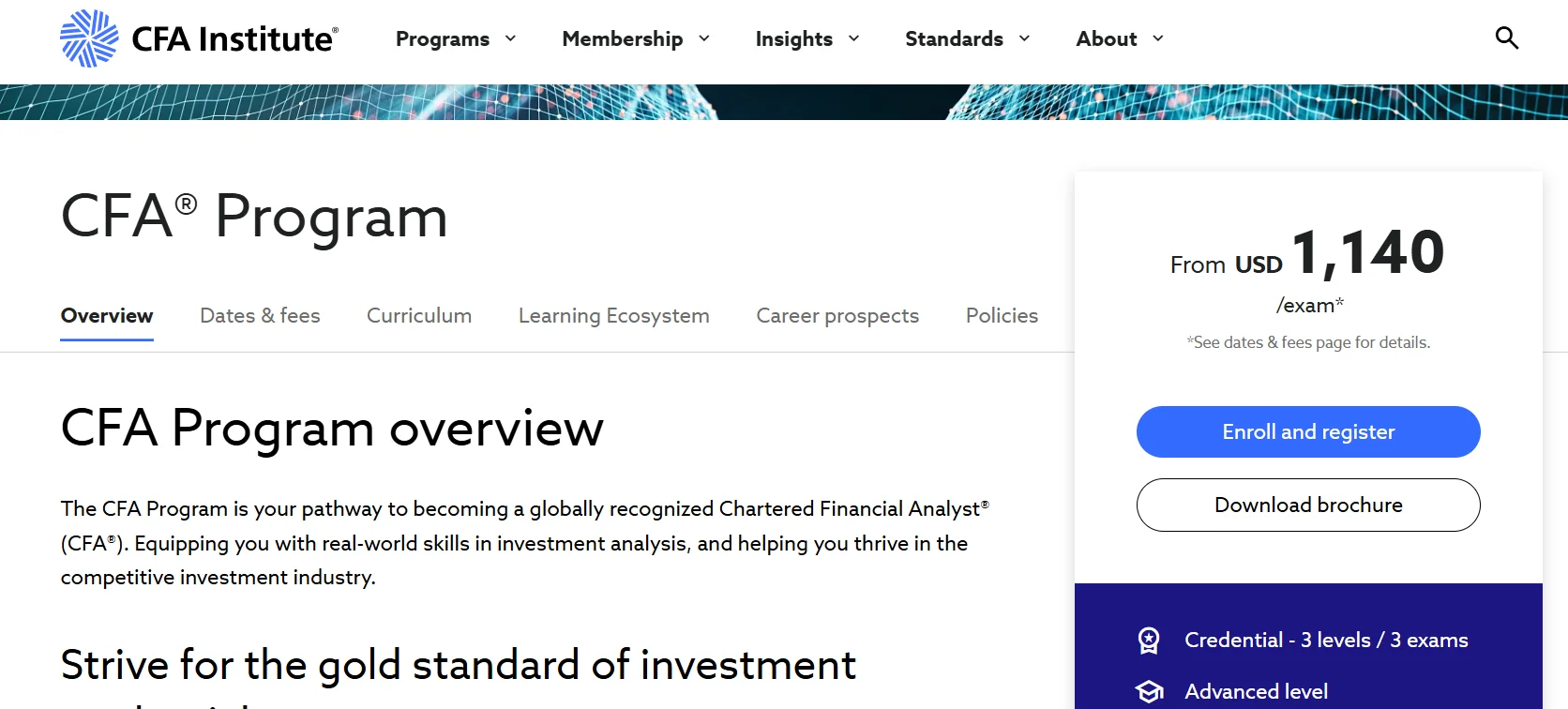
Best For: Investment management, portfolio management, and equity research professionals
Overview
The CFA charter is the most prestigious credential in investment management, offered by the CFA Institute. It represents the gold standard for investment professionals globally.
Certification Structure
The CFA program consists of three progressive levels:
- Level 1: Foundational knowledge of investment tools
- Level 2: Asset valuation and application
- Level 3: Portfolio management and wealth planning
Cost Structure
New 2026 Pricing (Enrollment Fee Eliminated):
- No enrollment fee (previously $350)
- Level 1 Early Registration: $1,140 (increased from $990)
- Level 1 Standard Registration: $1,490 (increased from $1,290)
- Level 2 Early Registration: $1,140 (increased from $990)
- Level 2 Standard Registration: $1,490 (increased from $1,290)
- Level 3 Early Registration: $1,240 (increased from $1,090)
- Level 3 Standard Registration: $1,590 (increased from $1,390)
Total Cost:
- Minimum (all early registrations): $3,520
- Maximum (all standard registrations): $4,570
- Additional costs: Study materials ($750-$1,500 per level)
Time to Complete
- Minimum duration: 2-4 years
- Study time per level: 300-400 hours
- Pass rates: 40-45% per level
- Exams offered: Four times per year
Requirements
- Bachelor’s degree or equivalent
- 4,000 hours of qualified work experience
- Pass all three levels
- Member of CFA Institute ($299 annually)
Career Impact
CFA charterholders work in:
- Portfolio management
- Investment research
- Risk management
- Asset management
- Private equity
- Hedge funds
Strengths
- Most prestigious finance credential globally
- Strong recognition in investment management
- Comprehensive investment education
- Global network of 200,000+ charterholders
Limitations
- Very expensive ($3,520-$8,000+ total with materials)
- Requires 2-4 years minimum
- Very difficult (low pass rates)
- More theoretical than practical
- Not focused on hands-on modeling
3. FRM (Financial Risk Manager)
Best For: Risk management professionals in banking, insurance, and financial institutions
Overview
Offered by the Global Association of Risk Professionals (GARP), the FRM certification is the leading credential for financial risk management professionals.
Certification Structure
Two-part examination system:
- Part 1: Foundations of risk management, quantitative analysis, financial markets
- Part 2: Application of risk tools, market risk, credit risk, operational risk
Cost Structure (2026)
Registration Fees:
- One-time Enrollment Fee: $400 (new candidates only)
- Part 1 Early Registration: $600
- Part 1 Standard Registration: $800
- Part 2 Early Registration: $600
- Part 2 Standard Registration: $800
Total Minimum Cost:
- Early registration both parts: $1,600 (plus $400 enrollment)
- Total: $2,000
Additional Costs:
- Study materials: $400-$800 per part
- GARP membership: $195 annually (optional)
- Calculator: $50-$150
Time to Complete
- Typical duration: 6-12 months
- Study time per part: 200-240 hours
- Exams offered: Three times per year (May, August, November)
Requirements
- No formal education requirement to sit for exam
- Two years of professional work experience in risk management
- Experience must be submitted within 5 years of passing Part 2
Career Impact
FRM certified professionals work in:
- Risk management departments
- Investment banks
- Commercial banks
- Asset management firms
- Insurance companies
- Regulatory bodies
Strengths
- Focused specifically on risk management
- Strong industry recognition in banking
- Faster completion than CFA
- More affordable than CFA
- No strict educational prerequisites
Limitations
- Limited to risk management roles
- Not as prestigious as CFA
- Requires self-motivation for exam prep
- Work experience verification required
4. CPA (Certified Public Accountant)
Best For: Accounting professionals, auditors, tax specialists, and financial reporting experts
Overview
The CPA is the premier accounting credential in the United States, issued by the American Institute of Certified Public Accountants (AICPA). It is essential for public accounting and highly valued in corporate finance.
Certification Structure
Four exam sections (as of CPA Evolution):
- Three core sections
- One discipline section (choose from Taxation, Information Systems, or Finance)
Cost Structure (2026)
Exam Fees:
- Application/Evaluation Fee: $50-$200 (varies by state)
- Registration Fee per Section: $93 (NASBA recommended)
- Exam Fee per Section: $262.64 (NASBA recommended)
- Total per section: approximately $355
- Total for 4 sections: $1,050-$1,420
Additional Costs:
- Study materials: $1,000-$3,000
- Ethics exam: $100-$150
- Licensing fee: $100-$500 (varies by state)
- Total realistic cost: $3,000-$7,000
Time to Complete
- Typical duration: 6-18 months
- Study time per section: 80-120 hours
- Exams available: Continuous testing windows throughout year
Requirements
2026 Changes – New Pathways:
- Traditional Path: 150 credit hours (bachelor’s + 30 additional)
- New Bachelor’s Pathway: Bachelor’s degree + 2 years experience + exam
- Additional accounting coursework requirements vary by state
Career Impact
CPAs work in:
- Public accounting firms (Big 4 and regional)
- Corporate accounting and finance
- Government accounting
- Tax consulting
- Forensic accounting
- CFO and controller positions
Strengths
- Highly respected in accounting profession
- Required for public accounting
- Strong salary premium
- Versatile career applications
- State licensure provides credibility
Limitations
- Primarily accounting-focused
- State-specific requirements
- Expensive total cost
- Requires ongoing CPE credits
- Limited to U.S. (not global like CFA)
5. Coursera Finance Certificates
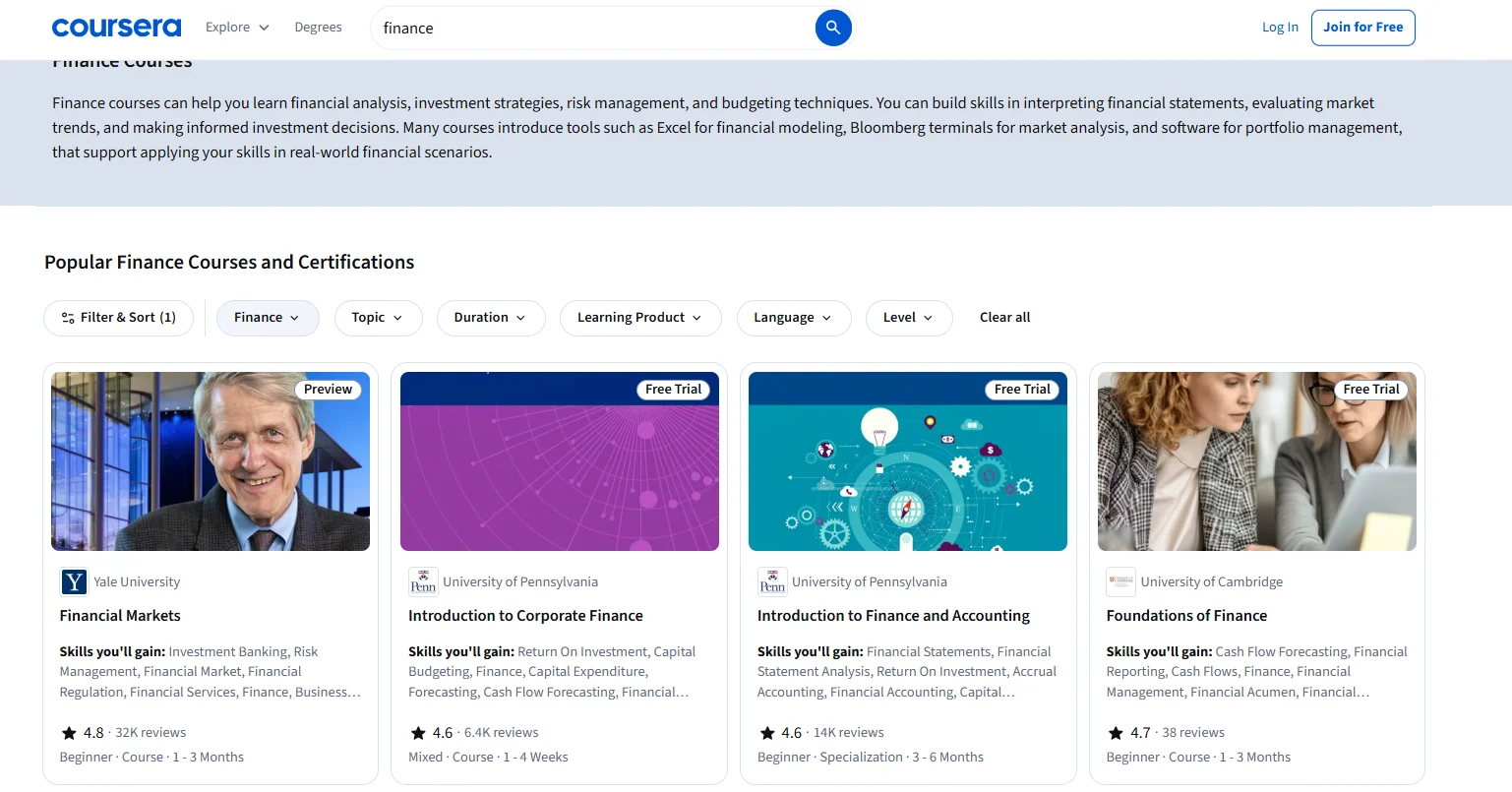
Best For: Learners seeking affordable, university-backed finance education across multiple topics
Overview
Coursera partners with top universities and companies to offer online finance courses, specializations, and degrees. It provides broad access to finance education from institutions like Yale, Stanford, and Wharton.
Available Programs
Professional Certificates:
- Google Data Analytics (with finance applications)
- IBM Data Analyst
- University-specific finance specializations
Specializations:
- Financial management
- Investment strategies
- Corporate finance
- Financial markets
- Accounting fundamentals
Full Degrees:
- Bachelor’s in finance
- Master’s in finance
- MBA programs
Cost Structure (2026)
Individual Courses:
- $29-$99 per course
- Audit option: Free (no certificate)
Specializations:
- $39-$79 per month
- Typical duration: 2-6 months
- Total cost: $80-$474
Coursera Plus:
- $399 per year (currently $199 with 50% discount)
- Access to 7,000+ courses
- Unlimited certificates
Degree Programs:
- Bachelor’s degrees: $10,000-$25,000
- Master’s degrees: $15,000-$40,000
Time to Complete
- Individual courses: 4-6 weeks
- Specializations: 3-6 months
- Degrees: 1-4 years
Strengths
- Wide variety of finance topics
- University-backed credentials
- Affordable individual courses
- Flexible learning schedule
- Free audit options available
- Global accessibility
Limitations
- Variable quality across courses
- Less specialized in practical finance skills
- Limited employer recognition in finance sector
- Monthly subscription can add up
- Minimal hands-on financial modeling
- More theoretical than practical
6. MBA in Finance

Best For: Professionals seeking comprehensive business education with finance specialization and leadership development
Overview
An MBA with finance concentration provides broad business education combined with specialized finance knowledge. Top programs offer networking, prestige, and access to elite career opportunities.
Program Types
Full-Time MBA:
- 2 years full-time study
- Internships and networking
- Campus-based learning
Part-Time MBA:
- 3-4 years while working
- Weekend or evening classes
- Maintain current employment
Executive MBA:
- 1.5-2 years for experienced professionals
- Cohort-based learning
- Higher cost but senior-level focus
Online MBA:
- Flexible schedule
- Lower cost than campus programs
- Growing employer acceptance
Cost Structure (2026)
Top-Tier Programs (Harvard, Stanford, Wharton):
- Tuition: $60,000-$150,000 per year
- Total cost: $120,000-$250,000
- Living expenses: $30,000-$60,000 per year
Mid-Tier Programs:
- Tuition: $40,000-$80,000 per year
- Total cost: $80,000-$160,000
Online MBA:
- Tuition: $20,000-$60,000 total
- More affordable but less networking
Time to Complete
- Full-time: 2 years
- Part-time: 3-4 years
- Executive: 1.5-2 years
- Online: 2-3 years
Career Impact
MBA graduates pursue:
- Investment banking
- Management consulting
- Corporate finance leadership
- Private equity
- Venture capital
- CFO and executive positions
Strengths
- Comprehensive business education
- Strong alumni networks
- Career switching opportunities
- Leadership development
- High earning potential
- Employer recognition
Limitations
- Very expensive ($80,000-$250,000)
- Requires 1-2 years out of workforce (full-time)
- Not specifically focused on technical finance skills
- Return on investment varies by program
- Opportunity cost of lost income
7. CAIA (Chartered Alternative Investment Analyst)

Best For: Professionals specializing in alternative investments like hedge funds, private equity, real estate, and commodities
Overview
The CAIA Association offers this specialized certification for professionals working with alternative investments. It is the only credential specifically designed for the alternative investment industry.
Certification Structure
Two-level examination system:
- Level 1: Introduction to alternative investments, asset allocation, risk management
- Level 2: Advanced topics in alternative investments, portfolio management
Cost Structure (2026)
Exam Fees:
- Enrollment Fee: $450 (one-time for new candidates)
- Level 1 Early Registration: $800
- Level 1 Standard Registration: $950
- Level 2 Early Registration: $900
- Level 2 Standard Registration: $1,050
Total Minimum Cost:
- Early registration: $2,150 (including enrollment)
- Standard registration: $2,450
Additional Costs:
- Study materials: $500-$1,200
- Membership: $395 annually (optional)
Time to Complete
- Typical duration: 6-18 months
- Study time per level: 200-250 hours
- Exams offered: Twice per year (March and September)
Requirements
- Bachelor’s degree or equivalent
- One year of professional work experience
- Or four years of professional experience without degree
Career Impact
CAIA charterholders work in:
- Hedge funds
- Private equity firms
- Venture capital
- Real estate investment
- Commodities trading
- Fund of funds management
- Alternative investment consulting
Strengths
- Only credential focused on alternative investments
- Growing recognition in hedge fund industry
- Faster than CFA (6-18 months vs. 2-4 years)
- More affordable than CFA
- Specialized knowledge valued by employers
Limitations
- Narrow focus limits career flexibility
- Less prestigious than CFA
- Limited to alternative investments
- Smaller global recognition
- Fewer charterholders than CFA
Comparison Table: All 7 Certifications at a Glance
| Certification | Total Cost | Duration | Best For | Industry Recognition |
| CFI | $298-$508/year | 3-6 months | Practical finance skills, modeling | High in finance sector |
| CFA | $3,520-$8,000+ | 2-4 years | Investment management | Very High globally |
| FRM | $2,000-$4,000 | 6-12 months | Risk management | High in banking |
| CPA | $3,000-$7,000 | 6-18 months | Accounting, audit, tax | Very High in accounting |
| Coursera | $80-$40,000 | Varies | Broad finance education | Moderate |
| MBA | $80,000-$250,000 | 1-4 years | Leadership, career switching | Very High |
| CAIA | $2,150-$4,000 | 6-18 months | Alternative investments | Moderate |
How to Choose the Right Certification for Your Career
Consider Your Career Goals
If you want to work in investment banking or corporate finance:
- First choice: CFI (FMVA or FPAP) for practical modeling skills
- Long-term: CFA for prestige and career advancement
If you want to specialize in risk management:
- Best choice: FRM
- Alternative: CFI (CBCA) for commercial banking focus
If you want to work in accounting or audit:
- Best choice: CPA
- Complement with: CFI for financial analysis skills
If you want to work in alternative investments:
- Best choice: CAIA
- Foundation: CFI for modeling basics
If you want career flexibility and leadership:
- Best choice: MBA
- Practical skills: CFI before or during MBA
Consider Your Budget
Limited budget ($300-$1,000):
- CFI provides maximum value
- Coursera Plus for broad learning
Moderate budget ($2,000-$5,000):
- FRM for specialized risk management
- CAIA for alternative investments
- CPA if pursuing accounting
Significant budget ($5,000+):
- CFA for investment management
- MBA for leadership positions
Consider Your Timeline
Need quick results (3-6 months):
- CFI certifications
- Individual Coursera specializations
Moderate timeline (6-18 months):
- FRM
- CPA
- CAIA
Long-term commitment (2-4 years):
- CFA
- MBA
Consider Practical vs. Theoretical Learning
If you prefer hands-on, practical learning:
- CFI excels at practical application
- Focus on building real models and templates
If you prefer academic, theoretical learning:
- CFA provides comprehensive investment theory
- Coursera university courses
- MBA programs
Final Recommendation: Why CFI Stands Out in 2026?
After analyzing all seven certifications, CFI emerges as the best overall choice for most finance professionals in 2026. Here is why:
Unbeatable Value
At $298-$508 per year, CFI provides access to seven complete certifications plus 250+ courses. You would pay more for a single CFA level or even a few Coursera specializations.
Practical Skills That Employers Want
CFI teaches exactly what you need for finance jobs: building financial models, Excel mastery, valuation techniques, and real-world analysis. These are the skills listed in every investment banking and corporate finance job description.
Fast Career Impact
Most CFI learners report career advancement within 3-6 months. Compare this to the 2-4 years required for CFA or MBA programs. You can start applying new skills immediately in your current role.
Industry Recognition
Major firms like Goldman Sachs, JPMorgan, and Deloitte use CFI to train their teams. The certifications are recognized specifically where they matter most: in finance and banking.
Flexible Learning
CFI works around your schedule. Study whenever and wherever you want, at your own pace, with lifetime access to materials.
Comprehensive Support
The Full-Immersion plan includes AI tutoring, expert guidance, model reviews, and career support at no additional cost.
Multiple Certification Options
Whether you want financial modeling (FMVA), FP&A (FPAP), data analysis (BIDA), or FinTech (FTIP), CFI has a specialized certification for your career path.
Frequently Asked Questions
❓Can I pursue multiple certifications simultaneously?
Yes, with CFI you get access to all certifications in one subscription. For others, you would need to register and pay for each separately.
❓Which certification has the best ROI?
CFI provides the best immediate ROI due to low cost and quick completion time. CFA and MBA have strong long-term ROI but require much larger upfront investment.
❓Do employers recognize these certifications?
All seven certifications are recognized, but in different sectors. CFA and CPA are most prestigious overall, while CFI is highly valued specifically in finance roles requiring practical skills.
❓Can I take these certifications while working full-time?
CFI, FRM, CPA, and CAIA are all designed for working professionals. CFA is possible but demanding. Full-time MBA requires leaving work, though part-time options exist.
❓Which certification is hardest?
CFA is generally considered the most difficult due to length, difficulty, and low pass rates. CFI is more accessible but still rigorous.
❓Should I get multiple certifications?
Many professionals combine certifications. Common combinations:
Any certification + MBA for leadership
CFI + CFA for investment management
CFI + CPA for corporate finance
CFI + FRM for risk management
Quicklinks:
- CFI Review : Is this Financial Modeling Institute Worth It?
- CFI Vs Coursera: Best Finance Learning Platform?
- Datacamp Vs Coursera: Which Offers Better Hands-On Learning?
- Udemy vs Pluralsight : Which Is Best for Career Growth?
Conclusion
The finance industry in 2026 offers multiple paths to professional credentialing, each with distinct advantages. While all seven certifications provide value, CFI stands out as the best overall choice for most finance professionals due to its affordability, practical focus, quick completion time, and strong industry recognition.
However, your ideal choice depends on your specific career goals, budget, and learning preferences. Consider your long-term objectives, evaluate the trade-offs, and choose the certification that aligns best with your professional aspirations.
For those seeking immediate, practical skills that directly apply to finance work, CFI is the clear winner. For specialized career paths or long-term prestige, the other certifications offer valuable alternatives.
The most important step is to start. The finance industry rewards continuous learning and professional development. Choose your certification, commit to the process, and take the next step in advancing your finance career.