
Jeff Bezos stepped back into the CEO chair for the first time since 2021, and he did it with a giant bet on physical AI. His startup Prometheus announced a $12 billion Series B round on June 11, valuing the company at roughly $41 billion. Add the earlier launch round, and total funding now tops $18 billion.
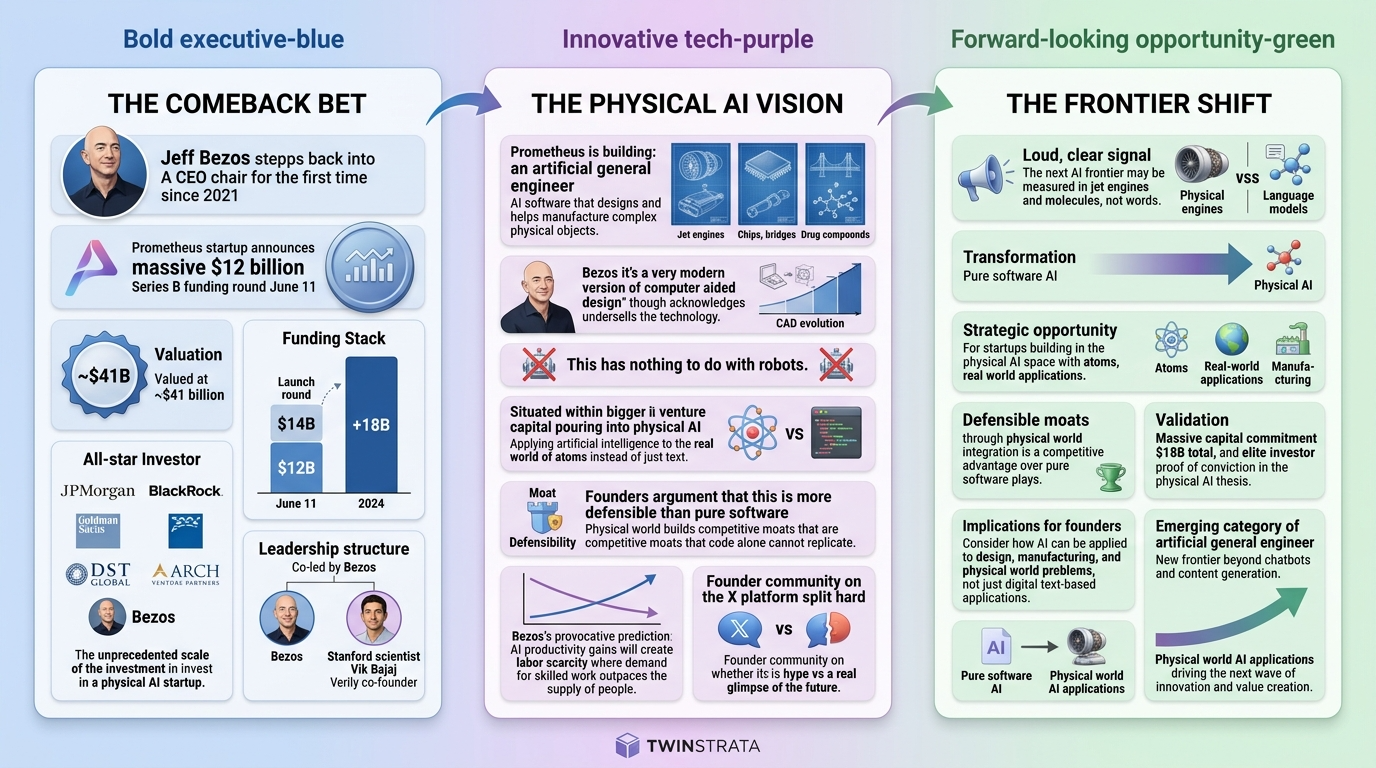
Prometheus is building what Bezos calls an artificial general engineer. The goal is AI software that designs and helps manufacture complex physical objects, from jet engines and chips to bridges and drug compounds.
Bezos describes it as a very modern version of computer aided design, though he says that undersells it. He was clear on one point. It has nothing to do with robots.
The investor list reads like a who’s who of finance. JPMorgan, BlackRock, Goldman Sachs, DST Global, and Arch Venture Partners all joined, along with Bezos himself. The company is co-led by Bezos and Stanford scientist Vik Bajaj, a Verily co-founder.
This round sits inside a bigger trend. Venture money is pouring into physical AI, the work of applying AI to the real world of atoms instead of just text. Founders argue it is more defensible than pure software, because the physical world builds moats that code alone cannot.
Bezos made one comment worth sitting with. He expects AI productivity gains to create what he calls labor scarcity, a world where demand for skilled work outpaces the supply of people. The founders reacting on X split hard on whether that is hype or a real glimpse ahead.
For startup builders, the signal is loud. The next AI frontier may be measured in jet engines and molecules, not words.
Quick Links: