
Anthropic has made a significant step forward in AI software development. A team of 16 parallel Claude Opus 4.6 AI agents built a complete C compiler from scratch in Rust. They did this with minimal human assistance.
The project ran for two weeks and cost about $20,000 in API fees. This experiment demonstrates that AI agents can handle large, complex coding tasks independently.
The agents worked together in Docker containers on a shared Git repo. They fixed bugs, added features, and optimized code. A simple script kept them running in loops.
The final compiler, called Claude’s C Compiler (CCC), has 100,000 lines of Rust code. It uses no external tools except the Rust standard library.
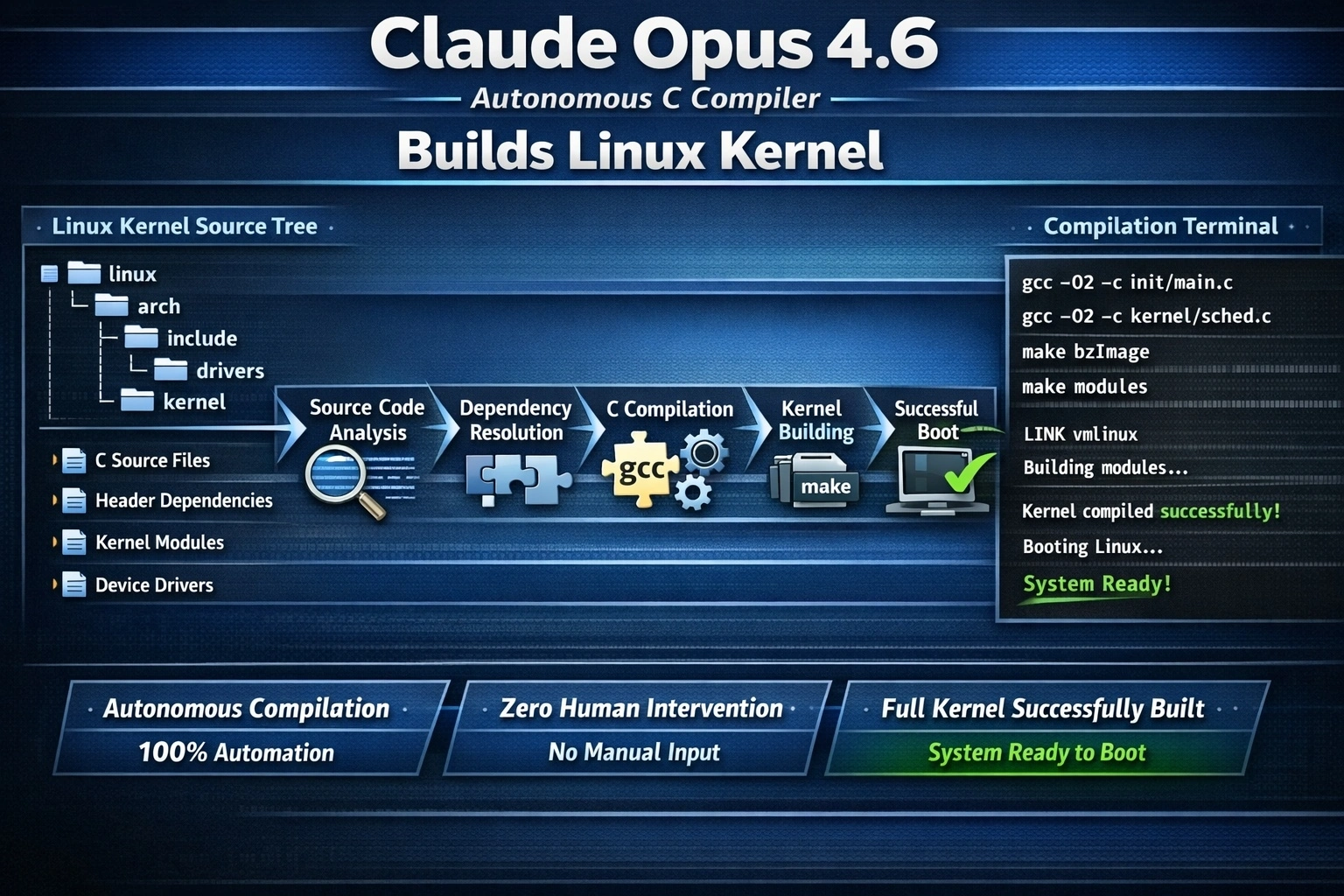
Key Achievements of the Claude C Compiler
- Supports x86, ARM, and RISC-V backends.
- Uses Static Single Assignment (SSA) for optimizations.
- Compiles Linux 6.9 kernel to make bootable systems.
- Builds big projects like QEMU, FFmpeg, SQLite, Postgres, Redis.
- Runs the classic game Doom.
- Scores 99% on GCC torture tests.
The compiler still calls GCC for some small parts, like 16-bit x86 boot code and the linker/assembler. Generated code works but runs slower than code from real compilers like GCC. The Rust code is solid but not at expert level yet.
Anthropic shared the full project on GitHub at github.com/anthropics/claudes-c-compiler. It includes all code and docs made by the AI agents.
For more details, check Anthropic’s official X post announcing the blog: https://x.com/AnthropicAI/status/2019496582698397945
This test highlights “agent teams” power. Multiple Claude instances coordinate without constant human input. It expands what LLMs can do alone. Nicholas Carlini led the work.
He wants to show AI’s future in autonomous development. It also emphasizes the need for robust testing and safety rules.
Experts say this accelerates progress in AI development. Future models may build huge software with almost no human help. Developers watch closely as tools like this rapidly change the industry.
More News To Read: