
The biggest startup story of the year, maybe the decade, happened this week. SpaceX went public. The company priced its IPO at $135 per share and raised roughly $75 billion. That values it at around $1.77 trillion, making it the largest initial public offering in recorded history. It now trades on Nasdaq under the ticker SPCX.
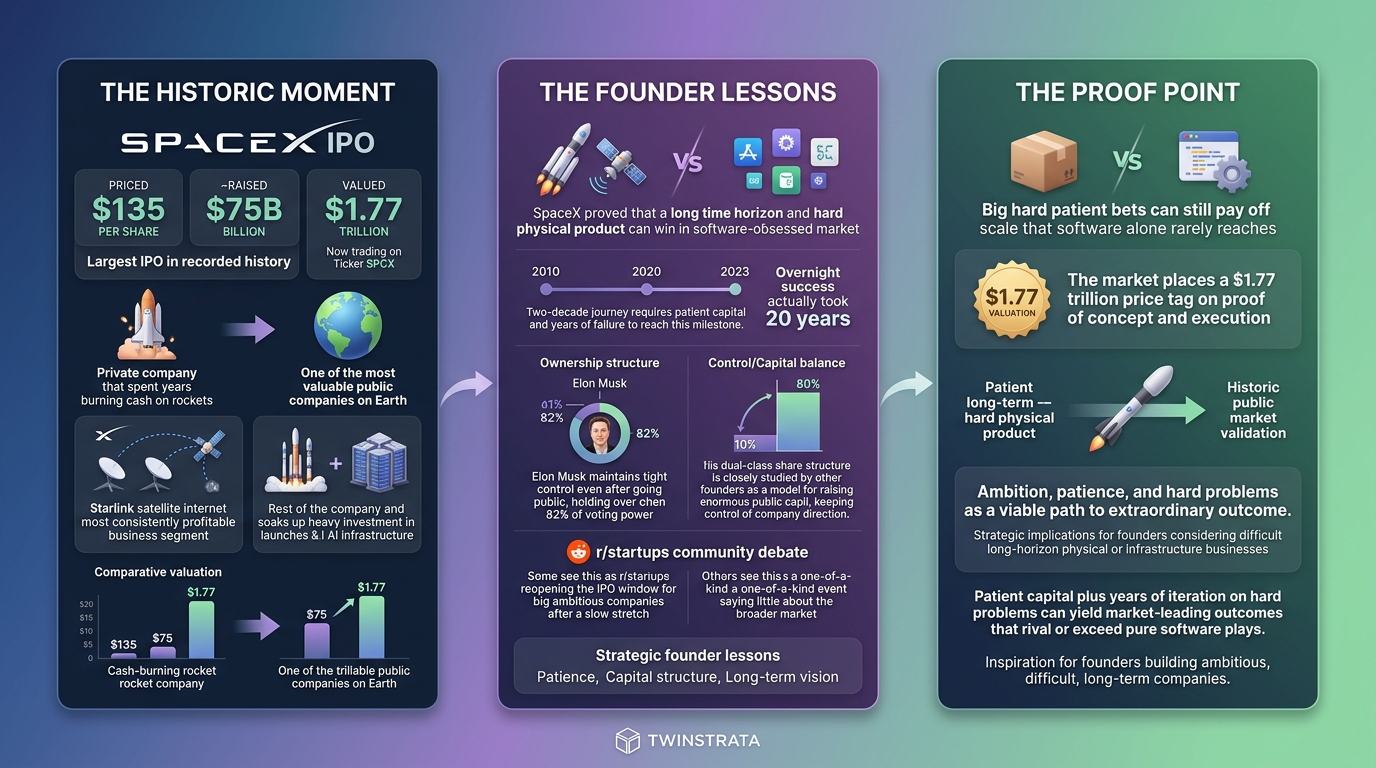
Let those numbers sink in. A private company that spent years burning cash on rockets is now one of the most valuable public companies on earth. Starlink, its satellite internet arm, remains the main revenue driver and the most consistently profitable part of the business. The rest still soaks up heavy investment in launches and AI infrastructure.
For founders, this IPO carries lessons beyond the headline. SpaceX proved that a long horizon and a hard physical product can win in a software obsessed market. It took patient capital and years of failure to reach this point. The overnight success took two decades.
Elon Musk keeps tight control even after going public, holding over 82 percent of the voting power. That is a structure other founders study closely. You can raise enormous public money and still keep the wheel.
The founders in r/startups spent the week debating what the listing signals. Some see it reopening the IPO window for big, ambitious companies after a slow stretch. Others see a one of a kind event that says little about the rest of the market.
The takeaway for your startup. Big, hard, patient bets can still pay off at a scale software alone rarely reaches. The market just put a $1.77 trillion price tag on proof.
Quick Links: