

WooCommerce is still a top choice in 2026, providing an easy way to build and manage an online store. If you need a flexible and cost-effective solution, WooCommerce is a great option.
- Free to use
- Easy to customize
- Scalable for growth
- Many payment options
- SEO-friendly
- Requires WordPress
- Needs regular maintenance
Price: $79/year
So you’re thinking about starting an online store, and everyone keeps recommending WooCommerce. But is it really the right choice, or is it one of those tools that seems perfect until you’re stuck in the settings late at night, wondering what went wrong?
I understand. Choosing the wrong platform can waste a lot of time. That’s why I’ve written this woocommerce review to give you a clear, honest answer.
I’ve worked with WooCommerce on real projects, so I know what works and what doesn’t. By the end of this review, you’ll know if WooCommerce is the right platform for your store or if you should consider other options.
Let’s get in.
What is WooCommerce?
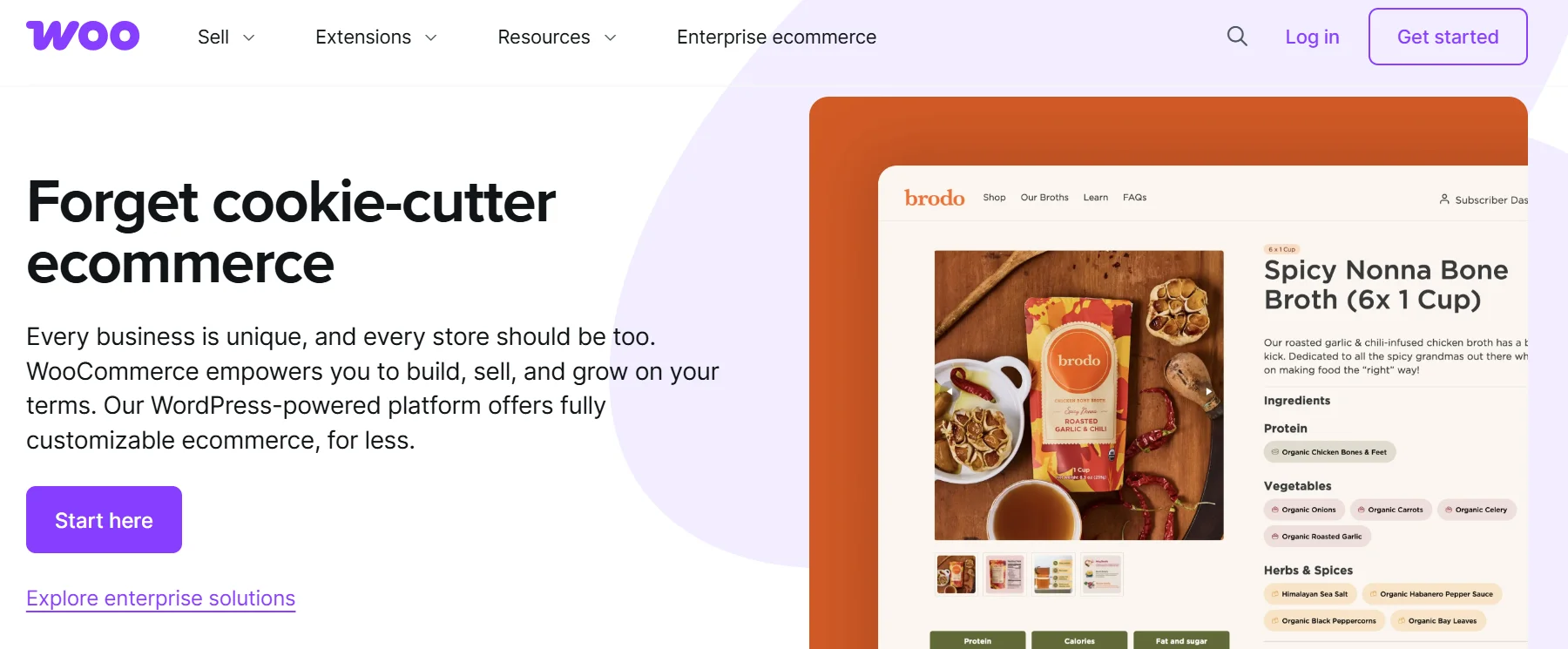
WooCommerce is an open-source e-commerce plugin designed for WordPress. WordPress, as you may already know, is one of the most popular content management systems (CMS) in the world, and WooCommerce builds on this foundation to turn a simple WordPress website into a fully-functional online store.
What makes WooCommerce so appealing is its flexibility. Whether you’re selling physical products, digital downloads, subscriptions, or services, WooCommerce can handle it all.
It’s free to use, with optional paid extensions that give you additional features, making it accessible for businesses of all sizes.
| Detail | Info |
|---|---|
| Founded | 2008 (as WooThemes) |
| Plugin Launch | September 27, 2011 |
| Founders | Magnus Jepson, Mark Forrester, Adii Pienaar |
| Original Developers | Mike Jolley, James Koster |
| Acquired by Automattic | May 2015 |
| Rebranded to Woo | October 2023 |
| Headquarters | San Francisco, CA (Automattic) |
| Team Size | 400+ globally (fully remote) |
| Active Stores | 4 million+ |
| Current Version | 10.5 (10.6 releasing March 10, 2026) |
| License | Free & Open Source (GPL) |
What Does WooCommerce Offer? (Key Features)
WooCommerce comes with a solid set of built-in features, and then an enormous ecosystem of extensions that let you add almost anything on top.
Product Management
You can sell physical products, digital downloads, virtual services, and subscriptions all from the same dashboard. Each product gets its own page where you set the price, description, images, stock level, weight, dimensions, and more.
If you sell products in multiple variations — different sizes, colors, or configurations — WooCommerce handles all of that with individual pricing, images, and inventory per variation.
The bulk editor lets you update dozens of products at once, which saves a massive amount of time as your catalog grows.
WooPayments (Built-In Payment Processing)
WooPayments is WooCommerce’s own built-in payment solution, powered by Stripe. It is free to install and lets you accept credit cards, debit cards, Apple Pay, Google Pay, and buy now pay later — all without your customers leaving your site.
For US-issued cards, the transaction fee is 2.9% + $0.30 per transaction, with an additional 1% for international cards. There is also an Instant Payouts feature that gets money into your account within 30 minutes, which is useful when cash flow matters.
Beyond WooPayments, you can connect PayPal, Stripe, Authorize.net, Square for in-person POS, and dozens of other gateways. WooCommerce does not charge any platform transaction fee on top of your gateway’s fees which is a big deal compared to Shopify’s model.
Shipping
WooCommerce ships with flat rate, free shipping, and local pickup options right out of the box. These cover most small stores perfectly well. If you need more, the free WooCommerce Shipping extension lets you print USPS and DHL labels directly from your dashboard and access discounted shipping rates.
For complex needs, multiple warehouses, real-time carrier rates, split shipments — extensions like Table Rate Shipping, Distance Rate Shipping, and ShipStation integration handle all of that.
Tax Management
WooCommerce calculates taxes automatically based on your customer’s location. You can set up different tax classes for different product types, and it handles EU VAT for digital goods out of the box.
For multi-region automated tax compliance, the Avalara integration keeps everything accurate and legally compliant without manual work.
SEO
This is genuinely one of WooCommerce’s biggest advantages. Because it runs on WordPress, you get clean URLs, customizable meta titles and descriptions on every product page, and schema markup that helps Google display rich snippets in search results — all with the help of some of the best WordPress plugins.
It integrates natively with Yoast SEO and Rank Math, the two most powerful SEO plugins available. If organic search traffic matters to your business, WooCommerce gives you a huge head start over platforms like Shopify, which have more limited SEO control.
Block-Based Checkout
WooCommerce has been rolling out a full block-based Cart and Checkout experience built on Gutenberg. In the latest versions, you can visually drag and drop your entire checkout layout without touching a single line of code.
Version 10.6 (releasing March 10, 2026) brings further refinements, including redesigned remove-item controls, sale badges displaying inline with prices, and cleaner product variation display. This makes the checkout experience both more customizable and more visually polished.
AI Store Setup Assistant (Woo AI)
Launched in 2024 and improved through 2025, the Woo AI assistant helps you during initial store setup. It can generate product descriptions, suggest category names, and draft homepage copy. It does not make decisions for you — you can override everything — but it dramatically cuts down the time it takes to go from a blank site to a populated store.
Coming soon in 2026: Sidekick-type AI functionality via extensions, which will allow AI-powered suggestions and automation directly inside the dashboard.
Analytics and Reporting
The built-in analytics dashboard gives you sales reports by date, product, and category. You can track revenue trends, see which products perform best, and monitor customer behavior, including lifetime value.
It is not as visually slick as some third-party tools, but it covers everything a growing store needs to make data-driven decisions without paying extra for an analytics platform.
Inventory Management
Stock tracking, low-stock notifications, backorder management, and stock level controls per product variation are all built in.
For larger stores with multiple warehouse locations, the Inventory Management for WooCommerce extension ($120–$150/year) adds real-time multi-location syncing and inventory forecasting.
Subscriptions and Memberships
WooCommerce Subscriptions ($279/year) lets you sell recurring products — weekly deliveries, monthly boxes, annual software licenses, anything with a repeating payment.
WooCommerce Memberships ($199/year) adds gated content, member-only pricing, and exclusive product catalogs. These two extensions together cover most subscription business models.
Extensions and Themes

The WooCommerce Marketplace has over 1,000 vetted extensions covering payments, shipping, marketing, CRM, accounting, and more. WordPress itself has over 1,000 themes with WooCommerce support — more than any other eCommerce platform.
Free and premium options exist across both. Popular integrations include Klaviyo, HubSpot, Mailchimp, QuickBooks, Xero, Google Shopping, Meta Ads, TikTok, ShipStation, and Square POS.
Mobile App
WooCommerce has an official mobile app for both iOS and Android. You can manage orders, view sales reports, update products, receive real-time notifications, and even scan barcodes to create new orders directly from your phone.
WooCommerce Pricing Plans
Let me clear something up straight away. WooCommerce the plugin is completely free. You download it, install it, and start using it — no cost. But running a real store involves more than just the plugin, and that is where costs come in.
| Cost Category | Low End | High End |
|---|---|---|
| Core WooCommerce Plugin | $0 | $0 |
| Hosting | $200/year | $20,000/year |
| Domain Name | $15+/year | $15+/year |
| Themes | $0 | $100/year |
| Design & Development | $500/year | $45,000/year |
| Shipping Tools | $0 + carrier fees | $100 + carrier fees |
| Payment Gateway Fees | 2.9% + $0.30/transaction | 2.9% + $0.30/transaction |
| Inventory Management | $120/year | $150/year |
| Accounting Tools | $100/year | $500+/year |
| Subscriptions & Memberships | $199+/year | $478+/year |
| Security (e.g. Jetpack) | $119/year | $250/year |
| GDPR/Compliance Tools | $50/year | $100/year |
| Email & Marketing Automation | $159/year | $720+/year |
| Loyalty/Affiliate Programs | $179+/year | $179+/year |
| UX/Conversion Enhancements | $49+/year | $199+/year |
| Total Estimated Annual Cost | ~$1,821+ | ~$67,791+ |
Key individual extension prices
- WooCommerce Subscriptions — $279/year
- WooCommerce Memberships — $199/year
- WooCommerce Points & Rewards — $179/year
- Affiliate for WooCommerce — $179/year
- AutomateWoo — $159/year
- Jetpack Security — from $119/year
- Inventory Management — $120–$150/year
- GDPR Compliance Extensions — $50–$100/year
What does a typical small store actually cost?
For a basic store with quality shared hosting, a free theme, and WooPayments — expect to spend around $300–$600/year all in. Add one or two premium extensions and you are looking at $700–$1,200/year.
That is significantly less than Shopify’s basic plan at $39/month ($468/year) plus apps that quickly push your total to $100–$200/month.
WooCommerce also offers a 30-day money-back guarantee on all paid extensions purchased through woocommerce.com.
Customer Support
Documentation Library: WooCommerce offers a large collection of free guides, videos, and troubleshooting articles that cover everything from basic setup to advanced features.
Community Forums: With a huge user base, the community forum has answers to most issues. A quick search online usually leads to solutions.
Ticket-Based Support: If you buy a paid extension, you get access to ticket-based support. Response times are typically within 24–48 hours on business days, but it only covers the extension, not the whole store.
Live Chat: Available for certain paid plans, offering real-time support through the WooCommerce Help Desk.
No Phone Support: WooCommerce does not offer phone support. For more complex help, you can hire a WordPress developer or use the Woo Agency Partner program to connect with vetted professionals.
Pros & Cons to Consider
Pros
- The core plugin is free.
- You own your store, data, and design with no lock-in.
- Only pay your payment gateway’s fee.
- Over 1,000 extensions, themes, and full code access.
- Works with Yoast and Rank Math for SEO optimization.
- Customize without coding
- Manage your store on iOS and Android.
- 30-day refund on paid extensions.
Cons
- Setup is more complicated than Shopify.
- Performance depends on your hosting plan.
- No phone support, mostly community-based.
WooCommerce vs. The Competition
| Feature | WooCommerce | Shopify | BigCommerce |
|---|---|---|---|
| Starting Price | Free (+ hosting) | $39/month | $29/month |
| Transaction Fees | None (gateway fees only) | 0.5–2% extra | None |
| Customization | Unlimited | Limited | Moderate |
| Hosting | Self-managed | Fully managed | Fully managed |
| SEO Control | Excellent | Good | Good |
| Ease of Use | Moderate | Easy | Moderate |
| Scalability | Very high | High | High |
| Data Ownership | Full | Platform-owned | Platform-owned |
| Support | Community + tickets | 24/7 managed | 24/7 managed |
Is WooCommerce Free?
People ask this a lot, so it deserves its own clear answer.
Yes — the WooCommerce plugin is 100% free. Download it from WordPress.org, install it, and activate it. No credit card needed.
No — running a real store is not free. You need hosting (from $200/year for quality managed hosting), a domain name ($15+/year), and depending on what you sell, you may need one or two paid extensions. A functional basic store typically costs $300–$600/year all in.
Compare that to Shopify at $39–$399/month just for the platform fee, and WooCommerce is significantly more cost-effective for most stores — especially as your revenue grows, since WooCommerce does not take a percentage of your sales.
FAQs
Do I need to know how to code to use WooCommerce?
No. The setup wizard, Woo AI, and block editor handle most things without code. Technical knowledge helps for customization, but it is not required.
Can WooCommerce handle a large store?
Yes. Stores with 25,000+ products and 175,000+ monthly visitors run successfully on WooCommerce. You just need quality hosting to match your scale.
What payment methods does WooCommerce support?
WooPayments (built on Stripe) handles cards, Apple Pay, Google Pay, and buy now pay later. You can also add PayPal, Stripe directly, Authorize.net, Square, and dozens more.
Is there a money-back guarantee?
Yes. WooCommerce offers a 30-day money-back guarantee on paid extensions purchased through woocommerce.com.
Quick Links
Final Thoughts
Here’s my conclusion.
WooCommerce isn’t as easy as Shopify. You handle your own hosting, updates, and plugin issues. That’s the trade-off.
But you get full control of your store, pay less, and can customize almost anything. As your business grows, you won’t face unexpected fees or forced upgrades.
In 2026, WooCommerce is better than ever. The AI assistant speeds up setup, block-based checkout simplifies design, and WooPayments handles payments. The community is strong and growing.
If you want control and flexibility, WooCommerce is still the best choice in 2026. Just be ready to put in the effort.