
Amazon has fundamentally reshaped the eCommerce landscape, transforming it into a dynamic marketplace and, for many, a veritable goldmine for profitable businesses.
If you are an aspiring entrepreneur eyeing the vast opportunities of online selling, an existing brand looking to expand your reach, or simply curious about the engine driving global commerce, understanding the latest Amazon seller statistics 2025 is paramount.
This detailed guide delves into the numbers, trends, and strategic insights you need to thrive on the world’s leading retail platform.
Amazon is not just a platform; it’s an ecosystem where millions of sellers connect with hundreds of millions of customers. Its dominance in online retail makes it an indispensable channel for businesses of all sizes.
The Seller Landscape: Who Sells on Amazon?
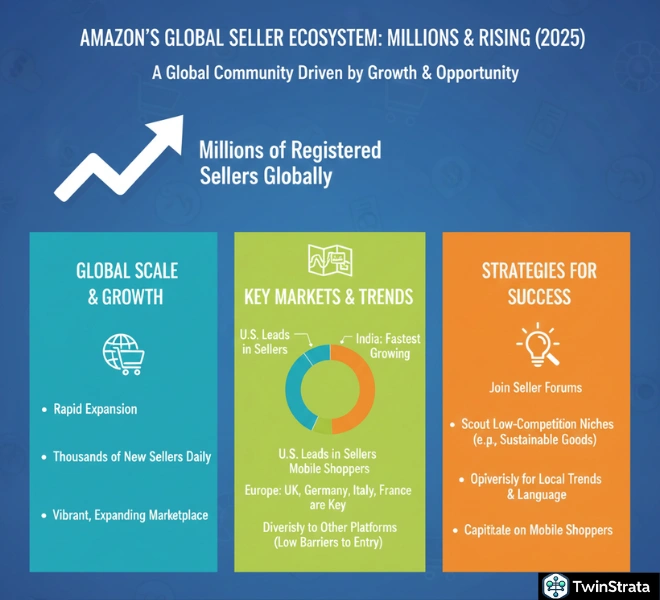
Let’s begin by examining the sheer scale and demographics of Amazon’s seller community. The platform thrives on its vast network of third-party merchants.
- Global Seller Base: Amazon currently hosts an astounding 9.7 million sellers worldwide. Out of this massive number, approximately 1.9 million sellers are actively promoting their products and services, showcasing the competitive yet active nature of the marketplace.
- USA’s Dominance: The United States alone boasts over 1.9 million Amazon sellers, accounting for a significant 60% of the total active seller base. This highlights the US as Amazon’s core market for merchants.
Here is a country-wise breakdown of Amazon sellers, illustrating its global reach:
| Country | Total Number of Amazon Sellers (approx.) |
| USA | 1.9 million |
| UK | 281,257 |
| Germany | 244,425 |
| Italy | 216,690 |
| France | 211,859 |
These numbers clearly indicate Amazon’s widespread international appeal and the opportunities it presents in various markets.
- eCommerce Market Share: In 2023, Amazon commanded an impressive 37.6% of the total eCommerce sales in the United States. This dwarfs its closest competitors, with Walmart at 6.4% and Apple at 3.6%, solidifying Amazon’s position as the dominant force in online retail.
- Fulfillment Choices: Sellers actively choose between Amazon’s fulfillment options. In 2023, 82% of Amazon sellers utilized the Fulfillment by Amazon (FBA) model, while 34% opted for Fulfillment by Merchant (FBM). This indicates a strong preference for FBA’s logistical advantages.
- Product Volume: Amazon sold over 4.5 billion items in 2023 in the United States alone. This translates to a mind-boggling average of 12 million products per day, 8,600 products per minute, and 143 products per second – a testament to the platform’s incredible transaction volume.
Also read about: Ways to Sell on Amazon Without Inventory
The Face of the Amazon Seller: Demographics
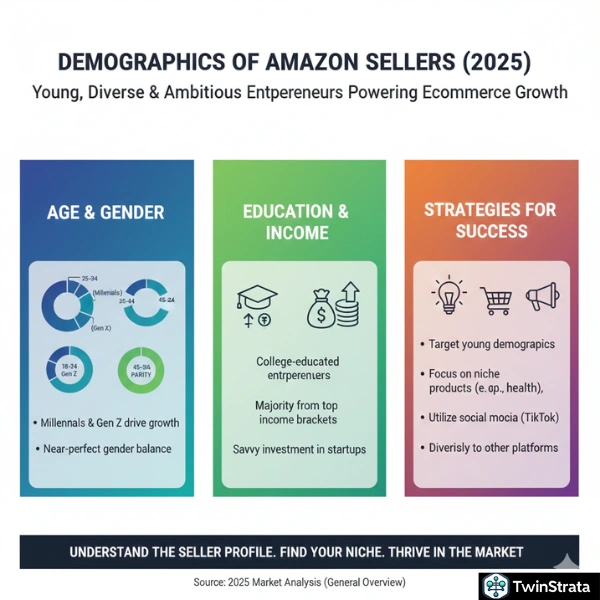
Understanding the demographics of Amazon sellers helps identify key trends and the types of entrepreneurs entering the market.
- Youthful Entrepreneurship: In 2023, 33% of Amazon sellers were aged between 25-34 years. This reveals that a substantial portion of Amazon’s seller community consists of young entrepreneurs actively building and growing their brands on the world’s leading retail platform.
Here is a chart illustrating the demographics of Amazon sellers by age in 2023:
| Age Group | Percentage |
| 18-24 years | 11% |
| 25-34 years | 33% |
| 35-44 years | 31% |
| 45-54 years | 15% |
| 55-64 years | 7% |
| 65 years and older | 3% |
- Gender Distribution: In 2023, 53% of Amazon sellers were male, while 47% were female. This shows a relatively balanced gender distribution within the seller community.
Also read about: How to Use Amazon Sponsored Brands Ads?
Product Insights: What Sells and Where It Comes From
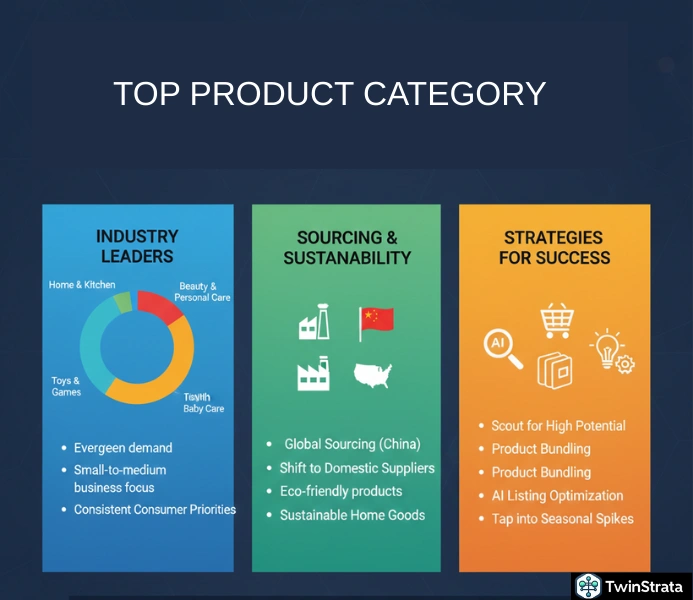
Successful selling on Amazon hinges on understanding product sourcing and the most popular categories.
- Sourcing from China: In 2023, a significant 71% of Amazon sellers in the United States sourced their products from China. This highlights a substantial reliance among Amazon sellers on Chinese manufacturers for efficient and cost-effective product sourcing.
- Leading Product Categories (SMBs): “Home and Kitchen” stands out as the leading product category among small and mid-sized enterprise (SMB) sellers in 2024, accounting for more than 35% of the total.
This category is followed by other strong performers:
- Beauty and Personal Care (26%)
- Clothing, Shoes, and Jewelry (20%)
- Toys and Games (18%)
Here is a table listing the top ten most popular product categories among Amazon SMB sellers in 2024:
| Product Category | Number of Sellers (in %) |
| Home and Kitchen | 35% |
| Beauty and Personal Care | 26% |
| Clothing, Shoes, and Jewelry | 20% |
| Toys and Games | 18% |
| Health, Household, and Baby Care | 17% |
| Electronics | 15% |
| Sports and Outdoors | 14% |
| Patio, Lawn, and Garden | 12% |
| Office Products | 10% |
| Pet Supplies | 9% |
Note: These percentages can overlap as sellers might sell in multiple categories.
Also read about: Amazon Statistics
The Customer Journey: How Shoppers Find and Buy
Understanding how consumers search for and purchase products on Amazon is crucial for optimizing your listings and marketing strategies.
- Amazon as Starting Point: A compelling 66% of consumers in the United States begin their product searches directly on Amazon when shopping online. This demonstrates Amazon’s primary role as a product discovery engine. Other starting points include:
- Search engines (42%)
- Walmart (29%)
- YouTube (13%)
- Target (11%)
- Facebook (10%)
- TikTok (7%)
- Instagram (7%)
- The Power of Reviews: In 2023, 75% of US consumers read Amazon reviews before making a purchase. This underscores the critical importance of maintaining excellent product quality and actively managing your review section. Shoppers also check reviews on:
- Other retail marketplaces (91%)
- Search engines (70%)
- Brand sites (68%)
- Independent review sites (40%)
- Rapid Purchase Decisions: Amazon customers complete 28% of their purchases in 3 minutes or less, and 50% of purchases in less than 15 minutes. This incredibly fast buying cycle emphasizes the need for clear product information, competitive pricing, and efficient checkout processes.
The Prime Advantage: Memberships and Spending
Amazon Prime membership significantly influences customer behavior and sales volumes.
- Growing Prime Membership: The number of Amazon Prime members is expected to hit 180 million in the United States by the end of 2024, and global Prime membership is expected to surpass 220 million in 2025. This year-on-year growth is a testament to consumers’ keen interest in leveraging Prime benefits like faster shipping and exclusive deals.
- Prime Day Impact: Prime Day 2024 sales reached a staggering $14.2 billion USD, surpassing 2023’s sales total of $12.7 billion USD by 11%. This special sales event is a massive opportunity for sellers to boost their sales significantly. In 2025, summer Prime Day kicked off with $7.9 billion in sales on the first day in the US, with total US online revenue reaching $24.1 billion over the entire event.
FBA’s Efficiency: Fueling Seller Success
Fulfillment by Amazon (FBA) is a cornerstone of many sellers’ strategies, offering powerful logistical advantages.
- FBA Reliance: 82% of Amazon’s third-party sellers worldwide depend on the Fulfillment by Amazon (FBA) model for their order fulfillment and shipping needs. This widespread adoption points to the efficiency and convenience FBA offers.
- Profitability with FBA: 46% of Amazon sellers achieve an average FBA success rate of 11-25% profit margins, with 64% becoming profitable within their first year. This demonstrates FBA’s effectiveness in contributing to seller profitability.
- Sales Boost: FBA can enhance Amazon sellers’ sales by 30-50%, primarily due to eligibility for Prime shipping, increased customer trust, and Amazon handling customer service for FBA orders.
Amazon’s Global Marketplace: Expansion and Growth
Amazon’s global presence continues to expand, opening new avenues for sellers.
- Worldwide Operations: Amazon currently operates in 20 marketplaces worldwide, including key regions like the USA, UK, Germany, India, Japan, and Australia, with the upcoming launch of its Ireland marketplace in 2025 expected to bring the total to 22 global stores.
- India’s Surge: India is Amazon’s fastest-growing marketplace, having surpassed the UK and Germany to become the second-largest marketplace (after North America) worldwide. This highlights the immense growth potential in emerging economies.
Revenue and Income: The Rewards of Selling on Amazon
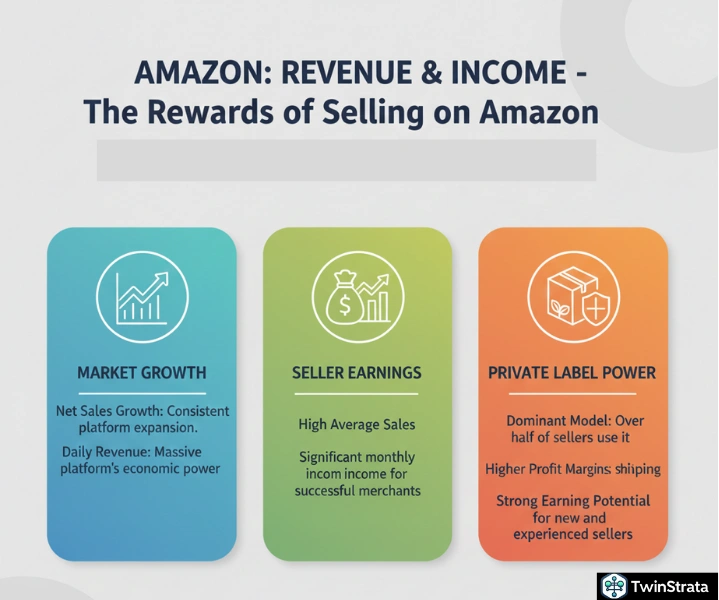
The financial statistics confirm Amazon’s potential for generating substantial revenue for its sellers.
- Net Sales Growth: Net sales on the Amazon platform increased by 7-11% from Q2 2024 to Q2 2025. This consistent growth signals a robust and expanding market.
- Daily Revenue: This growth brought Amazon’s daily average sales revenue to roughly $1.75 billion USD in 2025. This colossal figure reflects the platform’s economic power.
- Seller Earnings: Amazon sellers in the US averaged $290,000 million USD in sales in 2024. Furthermore, 50% of Amazon sellers in 2025 were generating between $10,000 and over $250,000 monthly. These figures indicate significant earning potential for successful merchants.
- Private Label Profitability: Over 60% of Amazon sellers now run private label brands, a model chosen by more than half of FBA users. This shift is driven by higher profit margins and greater scalability: Amazon private label sellers typically earn margins of 30–50%, compared to just 5–15% for dropshipping. New private label sellers on Amazon UK typically earn between £3,000–£7,000 per month, with experienced sellers reporting monthly earnings ranging from £15,000 to £25,000.
The Power of Third-Party Sellers
Third-party sellers are the backbone of Amazon’s marketplace, contributing significantly to its overall sales volume.
- Majority Share: Third-party sellers contributed to a dominant 60% of the total sales on the Amazon platform in 2024. This figure underscores Amazon’s reliance on its independent merchant community.
- High Volume Sales: Third-party sellers in the United States sold over 8,600 products per minute on Amazon last year, demonstrating their crucial role in moving vast quantities of merchandise.
Here is a chart showing the average share of paid units sold by third-party sellers on Amazon over the years:
| Year | Share of Sales Contributed by Third-Party Sellers on Amazon (in %) |
| 2025 | 60% |
| 2024 (Q1) | 61% |
| 2023 | 60% |
| 2022 | 57% |
| 2021 | 55% |
| 2020 | 53% |
The steady increase in the share of sales contributed by third-party sellers highlights their growing importance to Amazon’s business model.
The Role of AI and Innovations
Amazon is not just a retail platform; it’s a technology innovator, actively integrating AI and other advancements to enhance both customer and seller experiences.
- AI for Sellers: Currently, 34% of Amazon sellers use AI to create product listings, and 14% use it for social media content. This adoption streamlines operations and optimizes marketing efforts. Amazon’s AI Listing Builder, for example, crafts compelling SEO-optimized titles, bullet points, and descriptions in seconds.
- AI in Logistics: AI is integral to Amazon’s daily operations, with over 750,000 robots in its fulfillment centers. These robots increase efficiency by 75%, enabling Prime customers to receive their orders within one to two days.
- AI for Customers: In early 2024, Amazon introduced Rufus, an AI-powered shopping assistant designed to offer customers a more personalized shopping experience. Voice search also remains a significant trend, with 27% of the global online population using it on mobile devices, and Amazon’s Alexa continues to lead as the most widely used voice assistant worldwide.
- Sustainability Efforts: Amazon prioritizes ecological sustainability. In 2023, all of Amazon’s energy consumption was matched with renewable sources. Over 500 companies participate in Amazon’s program to achieve zero carbon emissions by 2040.
Marketing and Social Media Impact
In today’s interconnected world, social media and advertising play a crucial role in driving Amazon sales.
- Influencer Influence: In 2024, over 55% of Amazon customers admitted that social media influencers influenced their purchases. Amazon capitalizes on this trend with live streaming, where customers engage with influencers in real-time discussions about featured products. Approximately one-fifth of Gen Z users actively watch these live streams.
- TikTok’s Power: Nearly half of Amazon Prime members use TikTok, and 72% of Gen Z begin their shopping journey there. TikTok’s influence is profound; products like the Stanley Cup have gone viral and become top sellers on Amazon, generating millions in revenue.
- Amazon Ads Effectiveness: Amazon ads are renowned for significantly enhancing product visibility and driving sales. In 2023, Amazon generated $46.9 billion in revenue worldwide from advertising sales, marking a notable 24% increase from the previous year. Nearly half of Amazon customers have acknowledged purchasing products through Amazon ads, with an average cost-per-click (CPC) of $0.98 and an average advertising cost of sales (ACoS) of 28.97%.
What Users Are Asking: Insights from Quora and Reddit
To provide the freshest and most relevant insights for aspiring and current sellers, we look at common questions and discussions from platforms like Quora and Reddit. These reflect real-world concerns and interests related to selling on Amazon.
- “Is Amazon FBA still profitable in 2025, or is it too saturated?” This is a perennial question, indicating that sellers are looking for reassurance and strategies to stand out in a competitive market. The statistics suggest profitability is still very much possible, especially with strategic product research and marketing.
- “What are the best low-cost products to sell on Amazon to start?” New sellers are seeking entry points with minimal risk. This shows a demand for data-driven product selection and an understanding of niche markets rather than just chasing popular items.
- “How can I deal with hijacked listings or fake reviews on Amazon?” Sellers are concerned about brand protection and maintaining their reputation. This highlights the need for vigilance and knowledge of Amazon’s seller policies and tools to combat such issues.
- “What are the most effective ways to drive external traffic to my Amazon listings?” Beyond Amazon’s internal search, sellers are looking for ways to leverage social media, advertising, and other channels to increase visibility and sales, reflecting the growing importance of a holistic marketing strategy.
- “How much capital do I really need to start selling on Amazon FBA and become profitable?” Potential sellers want a clear financial roadmap. They are looking for realistic estimates on startup costs, inventory investment, and operational expenses to plan their ventures effectively.
These discussions reveal that sellers are constantly seeking practical advice on profitability, market entry, brand protection, external marketing, and financial planning, underscoring the need for comprehensive guidance and tools.
FAQs About Amazon Sellers Statistics
1. Is Amazon profitable for new sellers in 2025?
Yes, with niche research, FBA, and smart marketing, new sellers can thrive despite competition.
2. Advantages of Fulfillment by Amazon (FBA)?
FBA offers Prime eligibility, Amazon handles customer service, and it can boost sales by 30-50%.
3. Importance of customer review management?
Reviews are crucial, with 75% of U.S. consumers reading them before purchasing, influencing trust and visibility.
4. How does AI help Amazon sellers in 2025?
AI helps with SEO, content creation, customer service automation, and personalized shopping experiences.
5. Using TikTok to drive Amazon sales?
Create engaging viral content, use influencers, and share product links to capitalize on Gen Z shoppers.
Also Read:
- Smartphone Usage Statistics
- Google Ads Statistics
- Telegram Statistics
- Generative AI Statistics
- Email Marketing Statistics
Final Thoughts: Your Blueprint for Amazon Success
Amazon offers an unparalleled platform to take your business online, boost your sales revenue, and gain instant access to an established customer base of millions. The Amazon seller statistics 2025 paint a clear picture of a dynamic, growing, and immensely profitable marketplace.
To maximize your benefit from this platform, you must embrace data-driven decisions. Understand the demographics of your target customers, choose profitable product categories, optimize your sourcing, and strategically leverage fulfillment options like FBA.
Furthermore, engaging with the ever-evolving trends, such as the rise of AI in operations and the influence of social media in marketing, will position you for sustained success.
The future of eCommerce is undeniably intertwined with Amazon, and with the right approach, you can carve out your lucrative niche within its vast ecosystem.