
Meta is eyeing the hottest corner of the internet: prediction markets. Mark Zuckerberg has reportedly told a team to build a standalone app where people bet on real-world events. The twist that makes it interesting, and avoids calling it gambling, is that no real money is involved. It runs on points, not cash.
Here is the quick version:
A new app called Arena. Zuckerberg directed a small team to build a standalone prediction market app, separate from Facebook and Instagram.
Points, not money. In its current form, users earn points for correct predictions instead of wagering real cash.
AI runs it. Meta’s Llama model would generate the questions and resolve outcomes.
What Arena is
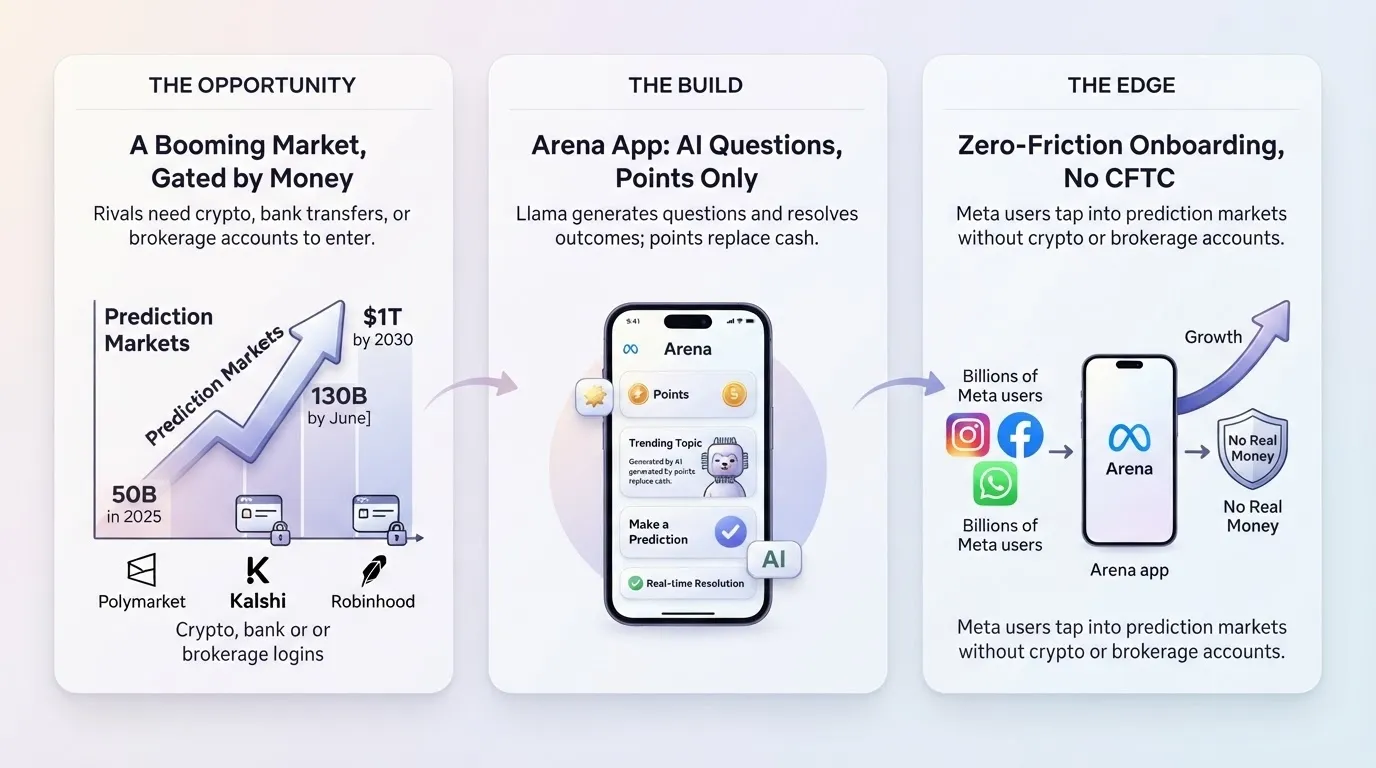
This is Meta chasing a booming category. According to The New York Times, Zuckerberg directed a small team to build a standalone prediction market app called Arena, where people forecast outcomes on politics, sports, entertainment, and world affairs using a video game-style points system rather than real money.
The AI angle is central, not cosmetic. Internal documents reviewed by NPR show the app, codenamed “Antwerp” and “FBForecast,” would use Llama to automatically generate questions from trending topics, make personalized market recommendations, and resolve markets in near real-time, meaning the AI has the final say on whether something happened.
https://www.youtube.com/shorts/8-8WjK0SRDA
There is history here too. Meta ran a crowdsourced prediction app called Forecast in 2020 and shut it down two years later, citing the operational cost of manually curating questions, and the new app is described internally as a rebuild of that effort. AI question generation is how Meta solves the cost problem that killed the first try.
Why no real money is the smart part
It sounds odd to build a betting app with nothing to win. But the no-money design is the strategy, not a limitation. Every major rival forces a financial hurdle. Polymarket requires crypto deposits, Kalshi requires bank transfers and regulatory compliance, and Robinhood requires a brokerage account, while Arena removes all of that, letting an Instagram user tap into a prediction game with zero financial setup.
That onboarding edge is the real moat, and it exists precisely because no money changes hands. It also keeps Meta clear of regulators. Arena avoids CFTC oversight by removing real-money wagers, unlike every major competitor in the space.
Why the timing makes sense
The market Meta wants in on is exploding. Combined prediction market trading volume reached $50 billion in all of 2025, then surpassed $130 billion through June 2026, with Bernstein estimating it could hit $1 trillion annually by 2030. With billions of users to funnel in, Meta is well placed to grab a slice fast.
Quick Links: