
IBM has taken one of its biggest setbacks in decades as the AI boom reshaped enterprise IT.
The company survived wars, recessions and multiple technology revolutions before this.
The pattern is old: incumbents lose not by ignoring a shift but by monetising it too slowly.
Some companies get disrupted by startups. Some get disrupted by a wave they were already standing in.
The setback
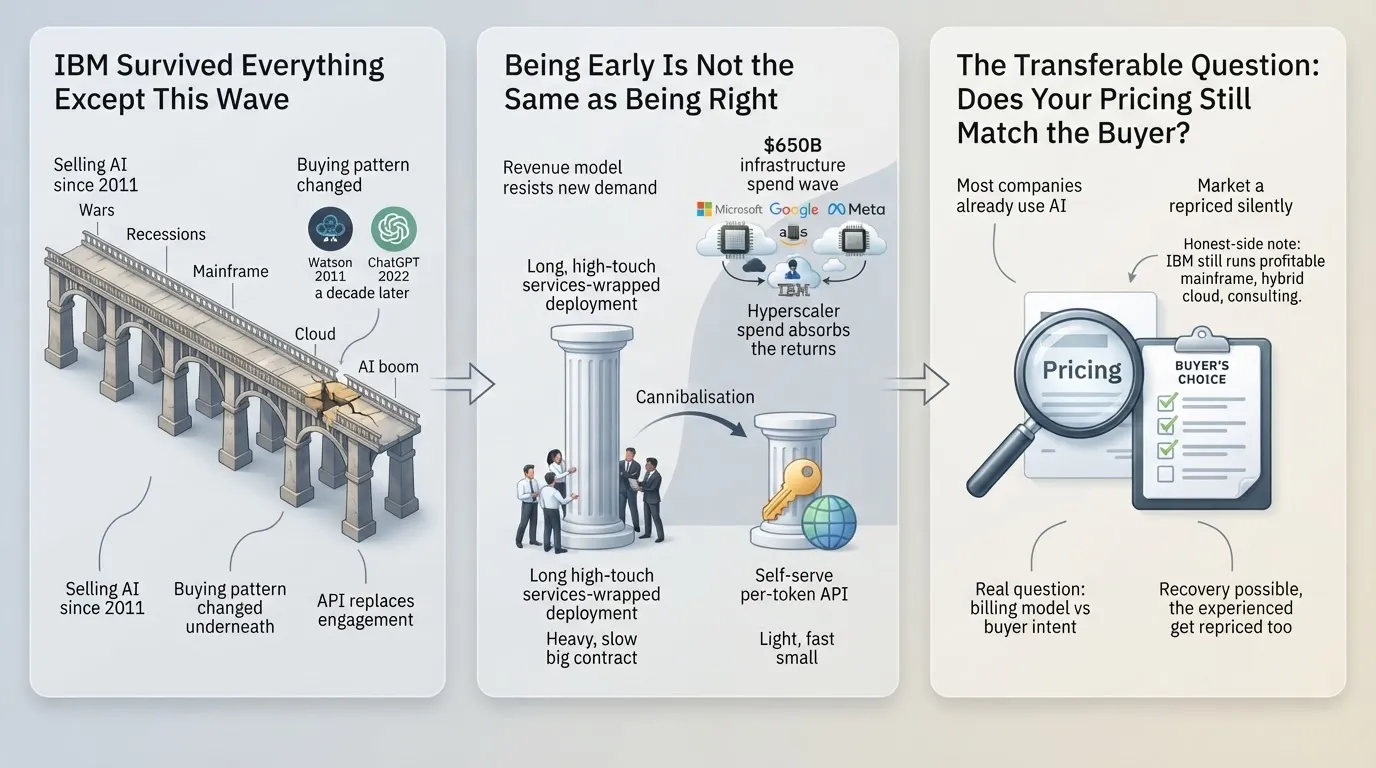
IBM has survived wars, recessions and multiple technology revolutions, but the AI boom has dealt it one of its biggest setbacks in decades.
That framing is doing the rounds this week, and it is worth taking seriously because IBM is not a company that missed AI. It has been selling AI longer than almost anyone.
Watch the breakdown here:
https://www.youtube.com/watch?v=_D0YMwS4Z7o
The uncomfortable truth is that being early is not the same as being right. IBM put Watson in front of the world in 2011, a decade before ChatGPT, and spent years selling AI into healthcare, finance and enterprise workflows.
Then the generative wave arrived, the buying pattern changed underneath it, and the customers who once needed a consulting engagement to deploy AI started buying an API instead.
The lesson that transfers
There is a pattern here that shows up in every technology cycle, and it is not “IBM was dumb.”
Incumbents lose because their revenue model resists the new shape of demand. IBM sells long, high-touch, services-wrapped deployments. Generative AI sells short, self-serve, per-token access. The second model cannibalises the first, so the org chart quietly fights it. Nobody makes a decision to lose. The decision gets made by a thousand people protecting the quarter.
Meanwhile the money went somewhere else entirely. Microsoft, Google, Amazon and Meta are collectively expected to spend around $650 billion on AI infrastructure in 2026, and the returns on that spending accrue to whoever owns the chips, the clouds, and the models. A services company sits downstream of all three.
For anyone building a business right now, the transferable question is not “am I using AI.” Almost everyone is. It is “does the way I charge still match the way my customers want to buy.” IBM’s answer stopped matching, and the market repriced it.
Worth noting the fair side: IBM still runs profitable mainframe, hybrid cloud and consulting businesses, and a bad stretch is not a death sentence for a company that has recovered from worse. But the story of 2026 is that the AI boom did not spare the experienced. It punished them for it.
Quick Links: