
The startup world loves a big vision. Founders are often coached to think big, pitch big, and go after the largest possible market. But the funding data from 2026 tells a story that points in the opposite direction, at least in the current moment. The startups raising money fastest, growing retention most consistently, and building the most durable competitive moats are the ones who went narrow on purpose.
Enterprise generative AI spend reached $37 billion in 2025, up from $11.5 billion the year before, as companies across industries moved from piloting AI tools to embedding them in core operations. Each AI startup that secured serious funding did so not simply because AI is in demand, but because they are building products that address problems with enough clarity and commercial potential to convince sophisticated investors to write large checks.
The phrase “enough clarity” is doing a lot of work in that sentence. In 2024, the AI hype cycle allowed fuzzy value propositions to attract capital. In 2026, the market has corrected, and investors want to understand exactly who uses the product, exactly what problem it solves, and exactly why a customer would choose it over the alternatives. Clarity is not just a pitch skill — it is evidence of product-market understanding.
Real examples of the vertical playbook working

Open Evidence, used by over 700,000 physicians as a clinical decision-support tool trained specifically on peer-reviewed medical literature and clinical guidelines, raised $250 million at a $12 billion valuation. The funding will expand integrations with hospital systems and accelerate development of specialty-specific AI modules for oncology, cardiology, and surgery.
That is a vertical AI product. It does not try to serve all professionals. It serves doctors. It does not try to answer all questions. It answers clinical questions backed by peer-reviewed evidence. The specificity is not a limitation of the product — it is the product. Doctors trust it precisely because it is designed for them.
Fazeshift, which uses AI agents to automate accounts receivable, raised $17 million Series A. That is the kind of narrow, specific problem with a clear ROI that investors are writing checks for right now. SaaS Ultra
Accounts receivable automation is not glamorous. It is not building a foundation model or creating a new computing paradigm. But it solves a real, painful, expensive problem for a specific buyer who understands the ROI immediately. That clarity is what drives both fundraising success and customer acquisition.
How to apply the vertical playbook as a new founder
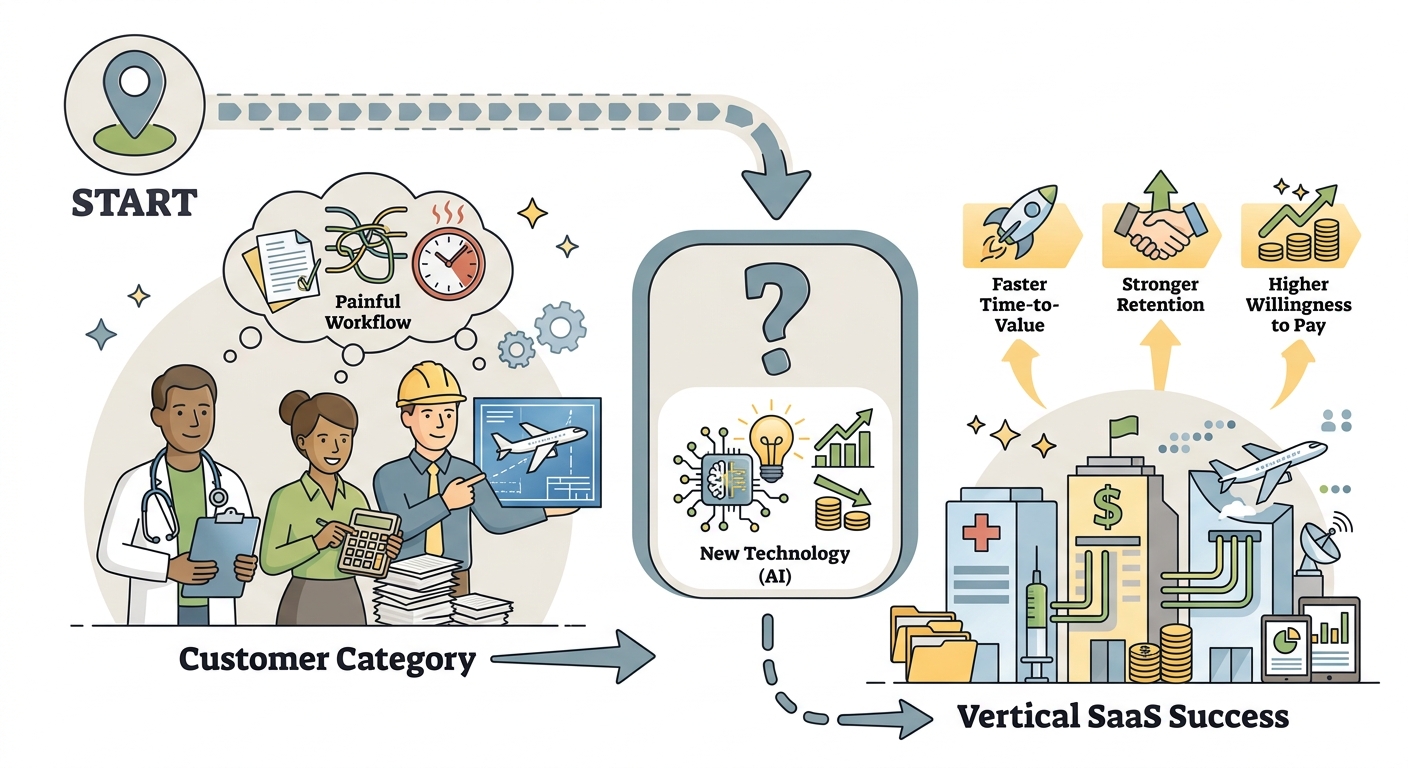
Start with a customer category, not a technology. Who are you building for? What is the most painful thing about their workflow that they would pay to fix? Then ask: is there a technology — specifically AI — that makes solving this problem newly possible or newly affordable? Technology is the enabler, not the starting point.
Industries like healthcare, finance, and aerospace are attracting targeted investments, with vertical SaaS solutions designed for specific industries seeing a surge in funding because they show faster time-to-value, stronger retention, and higher willingness to pay.
💬 Reddit signal: r/SaaS is full of “built in a weekend with AI” posts. The ones that turn into real businesses almost always follow the same pattern: the founder had a specific domain background, identified a specific pain point from personal experience, and built something for people exactly like themselves before expanding. Domain expertise plus AI tools is the winning combination.
🐦 Twitter/X signal: The most-shared startup success stories on X in 2026 are from founders who describe intentionally saying no to broader market opportunities to stay focused on one vertical. The counter-intuitive nature of this — being celebrated for doing less — is part of why these posts generate so much engagement.
The broad platform play is not dead. But it is a later-stage strategy, built on the back of a vertical win. The playbook that is working for new startups in 2026 is: go narrow, go deep, prove you can solve one problem better than anyone else, and then expand from a position of genuine strength.
Quick Links: