
Data breaches are no longer rare events. They have become a regular and costly threat for businesses of all sizes and across all industries.
As organizations store more data digitally and rely on cloud platforms, remote work, and AI tools, the attack surface continues to grow.
Recent data breach statistics clearly show that cybercriminals are highly motivated by financial gain. Personal data, healthcare records, and financial information remain the most valuable targets.
At the same time, many companies still lack strong security controls, governance frameworks, and breach response plans.
This article breaks down updated 2025 data breach statistics, explains what they mean, and shows how organizations can reduce their risk.
The goal is not just to present numbers, but to help decision-makers understand why breaches happen, how costly they are, and what can be done to prevent them.
Cost of a Data Breach in 2026
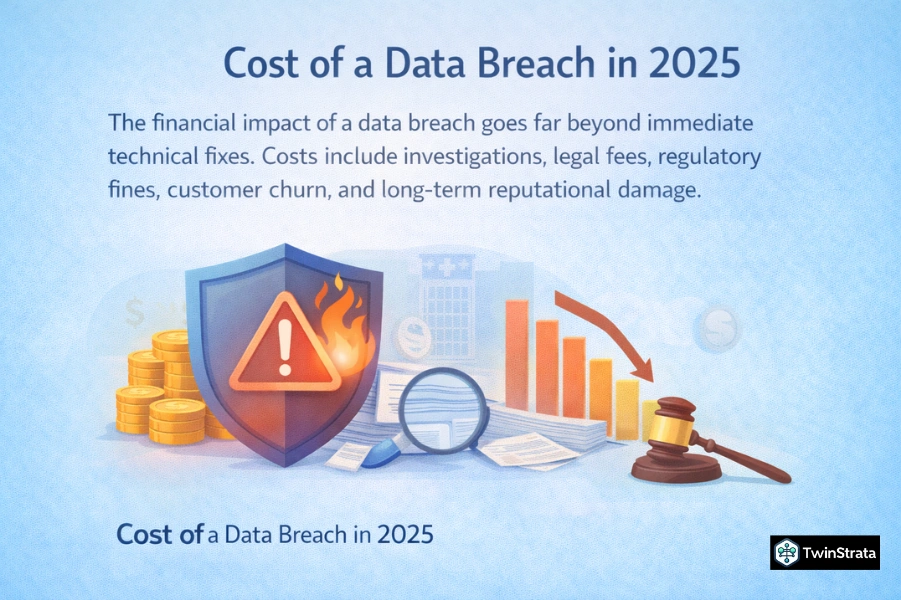
The financial impact of a data breach goes far beyond immediate technical fixes. Costs include investigations, legal fees, regulatory fines, customer churn, and long-term reputational damage.
Key Cost Statistics
- The global average cost of a data breach in 2025 is $4.44 million, slightly lower than the 2024 peak but still historically high.
- The average cost per compromised record is $160.
- Healthcare breaches remain the most expensive, with an average cost of $7.42 million per incident.
- Healthcare has held the top spot for breach costs for 12 consecutive years.
- Breaches that take more than 200 days to detect and contain cost an average of $5.01 million.
- Detection and escalation alone cost $1.47 million per breach.
- 51% of total breach costs occur within the first year, but long-term impacts often continue beyond that.
- The United States has the highest average breach cost, at $10.22 million.
- A mega breach involving 50–60 million records costs an average of $375 million.
Why Some Breaches Cost More
Several factors consistently increase breach costs:
- Delayed detection and response
- Weak regulatory compliance
- Poor identity and access management
- Phishing and stolen credentials as the attack vector
- Complex IT and security environments
Also read about: NordVPN Data Breach Denied After Hacker Claims Leak
Data Breaches by the Numbers
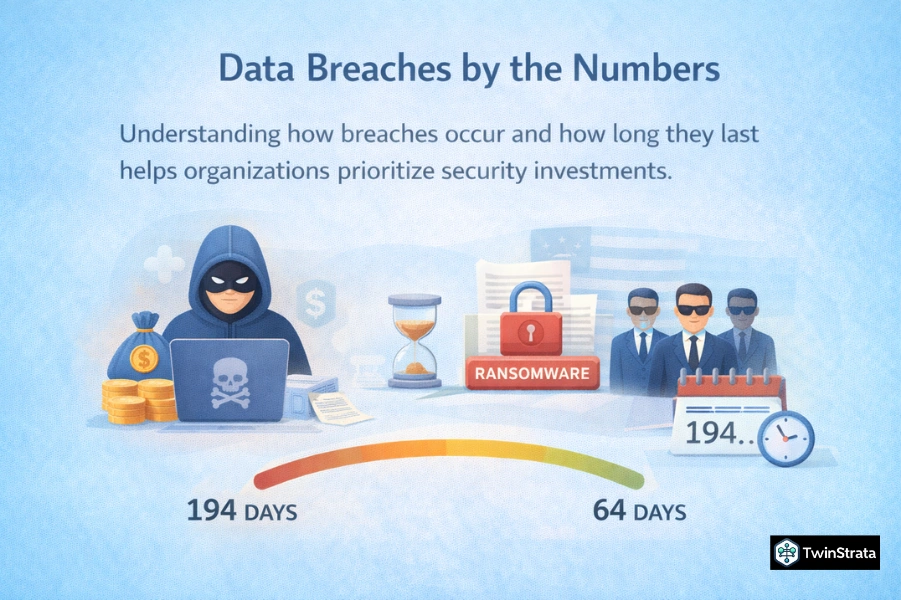
Understanding how breaches occur and how long they last helps organizations prioritize security investments.
How Data Breaches Happen
- 67% of breaches involve external attackers
- 30% involve internal actors, including employees and contractors
- 90% of breaches are financially motivated
- Ransomware is involved in 44% of breaches
- Only 10% involve nation-state attackers
Most breaches today are driven by organized cybercrime groups rather than political or espionage motives.
Breach Lifecycle and Response Time
- The average time to identify a breach is 194 days
- The average containment time is 64 days
- Breaches involving stolen credentials take the longest to resolve
- A breach resolved in under 200 days costs $1.39 million less on average
Key Data Breach Trends You Cannot Ignore
The scale of cybercrime continues to grow at an alarming rate.
- 6.06 billion malware attacks occurred globally in one year
- U.S. data breaches increased from 447 in 2012 to over 3,200
- Microsoft Office apps are the most exploited software globally
- Healthcare data exposure in the U.S. jumped from 5.3 million to 51.4 million records in five years
- Online fraud cost Americans $12.5 billion in one year
These figures show that no industry is immune.
Also read about: Ledger Data Breach Linked to Global-e, Customer Info Exposed
Remote Work and Data Breach Risk
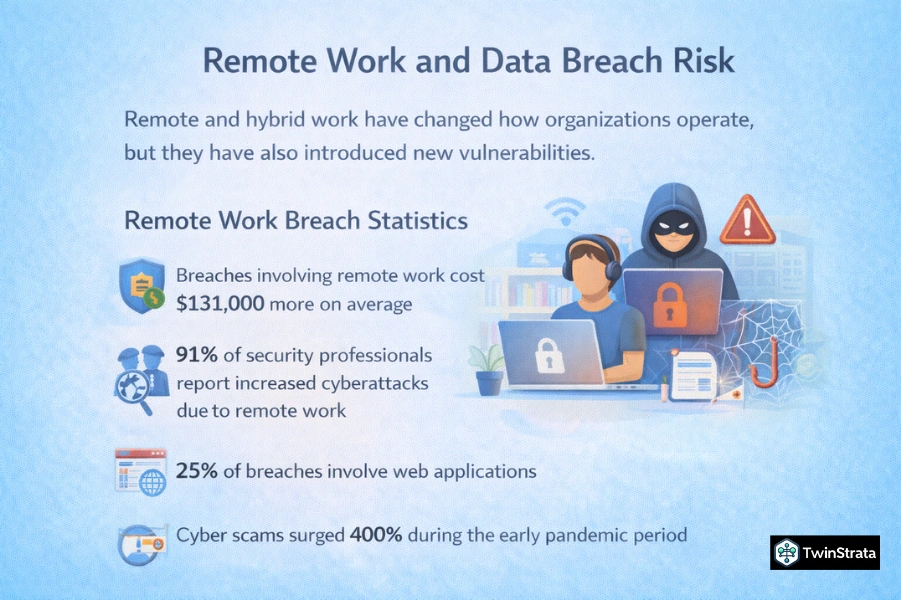
Remote and hybrid work have changed how organizations operate, but they have also introduced new vulnerabilities.
Remote Work Breach Statistics
- Breaches involving remote work cost $131,000 more on average
- 91% of security professionals report increased cyberattacks due to remote work
- 25% of breaches involve web applications
- Cyber scams surged 400% during the early pandemic period
Unsecured devices, weak VPNs, and poor access controls remain major risk factors.
AI Data Breach Statistics: A Growing Concern
Artificial intelligence is transforming business operations, but it also introduces new security risks.
AI-Related Breach Insights
- 16% of breaches in 2025 involved AI-powered attacks
- 37% of AI breaches used phishing
- 35% involved deepfake attacks
- 63% of organizations lack a mature AI governance policy
- 99% of companies expose sensitive data to AI tools
- Only 20% feel confident securing generative AI systems
AI increases both attack sophistication and the potential scale of damage.
Data Breach Risk Factors Inside Organizations
Many breaches happen not because of advanced hacking, but due to internal weaknesses.
- Employees often have access to millions of files
- 87% of organizations allow company-wide access to sensitive data
- 70% of sensitive data is stale or unused
- Only 5% of folders are properly secured
- 81% of breaches involve weak or reused passwords
- A cyberattack occurs every 39 seconds
These risks highlight the need for better access control and data governance.
Future Data Breach Projections
Cybersecurity threats are expected to intensify.
- Cybercrime costs may reach $10.5 trillion annually
- Climate-related disasters will increase phishing scams
- Online gambling and cryptocurrency adoption will attract attackers
- Critical infrastructure like power grids may become major targets
- One-third of organizations now rely heavily on security AI
Largest Data Breaches in History (Summary Table)
| Company | Year | Records Exposed |
| Cam4 | Unknown | 10 billion |
| Yahoo | 2013 | 3 billion |
| Marriott | 2018 | 500 million |
| 2019 | 540 million | |
| Equifax | 2017 | 145.5 million |
| Target | 2013 | 70 million |
What Is a Data Breach?
A data breach occurs when sensitive, confidential, or personal information is accessed without authorization. Data does not need to be stolen to qualify as a breach. Unauthorized access alone is sufficient.
Common Breach Methods
- Ransomware
- Malware
- Phishing
- Denial-of-Service attacks
- Insider misuse
- Human error
How Data Breaches Occur
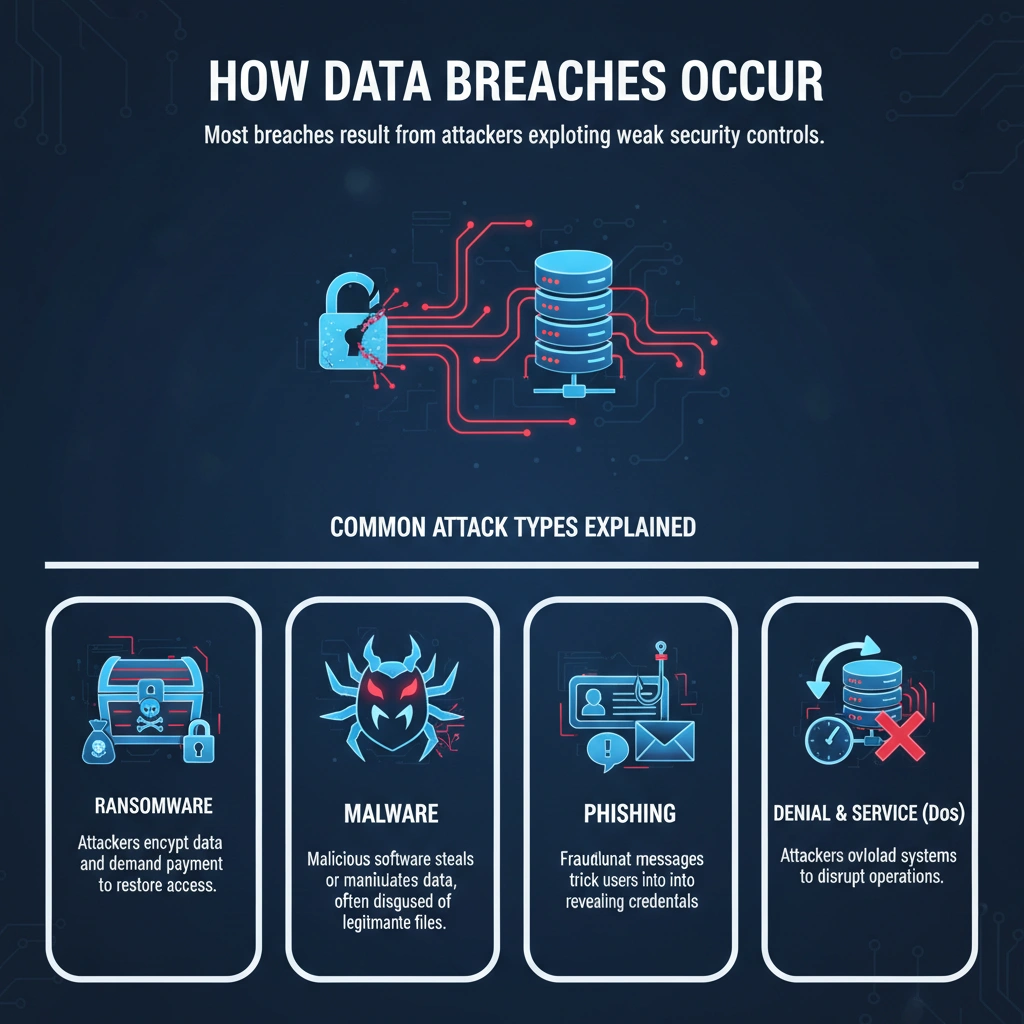
Most breaches result from attackers exploiting weak security controls.
Common Attack Types Explained
Ransomware
Attackers encrypt data and demand payment to restore access.
Malware
Malicious software steals or manipulates data, often disguised as legitimate files.
Phishing
Fraudulent messages trick users into revealing credentials.
Denial of Service (DoS)
Attackers overload systems to disrupt operations.
Data Breach Prevention: What Actually Works
Organizations are increasing cybersecurity investments, but prevention must be strategic.
Effective Prevention Measures
- Strong identity and access management
- Regular data classification and cleanup
- AI governance frameworks
- Security awareness training
- Incident response planning
- Vendor risk management
Spending Trends
- Security budgets grew by 6% on average
- Global cybersecurity spending exceeded $1.75 trillion
- Cloud security investments continue to rise
Data Breach Insurance Explained
Data breach insurance helps organizations recover financially after incidents.
Types of Coverage
First-Party Insurance
- Investigation costs
- Customer notifications
- Credit monitoring
- Crisis management
Third-Party Insurance
- Legal defense
- Settlements
- Regulatory fines
- Liability claims
FAQs About Data Breach Statistics
1. What is the average cost of a data breach in 2025?
The global average cost of a data breach in 2025 is $4.44 million, with healthcare breaches being the most expensive, costing up to $7.42 million.
2. How long does it take to detect and contain a breach?
On average, it takes 194 days to identify a breach and 64 days to contain it. Breaches involving stolen credentials take the longest to resolve.
3. What are the most common causes of data breaches?
Data breaches are often caused by external attackers (67%), phishing (44%), and poor internal access management (81% of breaches involve weak passwords).
4. How does remote work impact data breach risks?
Remote work increases breach costs by $131,000 on average, with 91% of security professionals reporting increased cyberattacks due to unsecured devices and weak VPNs.
5. What are the most effective data breach prevention measures?
Effective prevention includes strong identity and access management, security awareness training, and AI governance frameworks to protect sensitive data.
Also read about:
- DuckDuckGo Statistics
- Lead Generation Statistics
- Virtual Reality Statistics
- Referral Marketing Statistics
- US Immigration Statistics
Final Thoughts: Avoid Becoming a Statistic
The data is clear. Data breach statistics show rising costs, growing risks, and increasing attack sophistication. Organizations that delay security investments pay more later.
Prevention, governance, and awareness remain the most effective defenses. Companies that understand these trends and act early will be far better positioned to protect their data, customers, and reputation.