
The European Union officially began enforcing Article 50 of the EU AI Act on August 2, 2026. This is one of the most consequential regulatory moments in AI history.
Any company operating in the EU that uses AI to generate content, power chatbots, or create synthetic media now has legal obligations to disclose that AI is involved. The rules apply to providers and deployers of AI systems across all EU member states simultaneously.
What Article 50 Actually Requires
Article 50 sets out specific transparency requirements across several categories. First, AI chatbots must clearly inform users they are talking to a machine, unless that is already completely obvious from context.
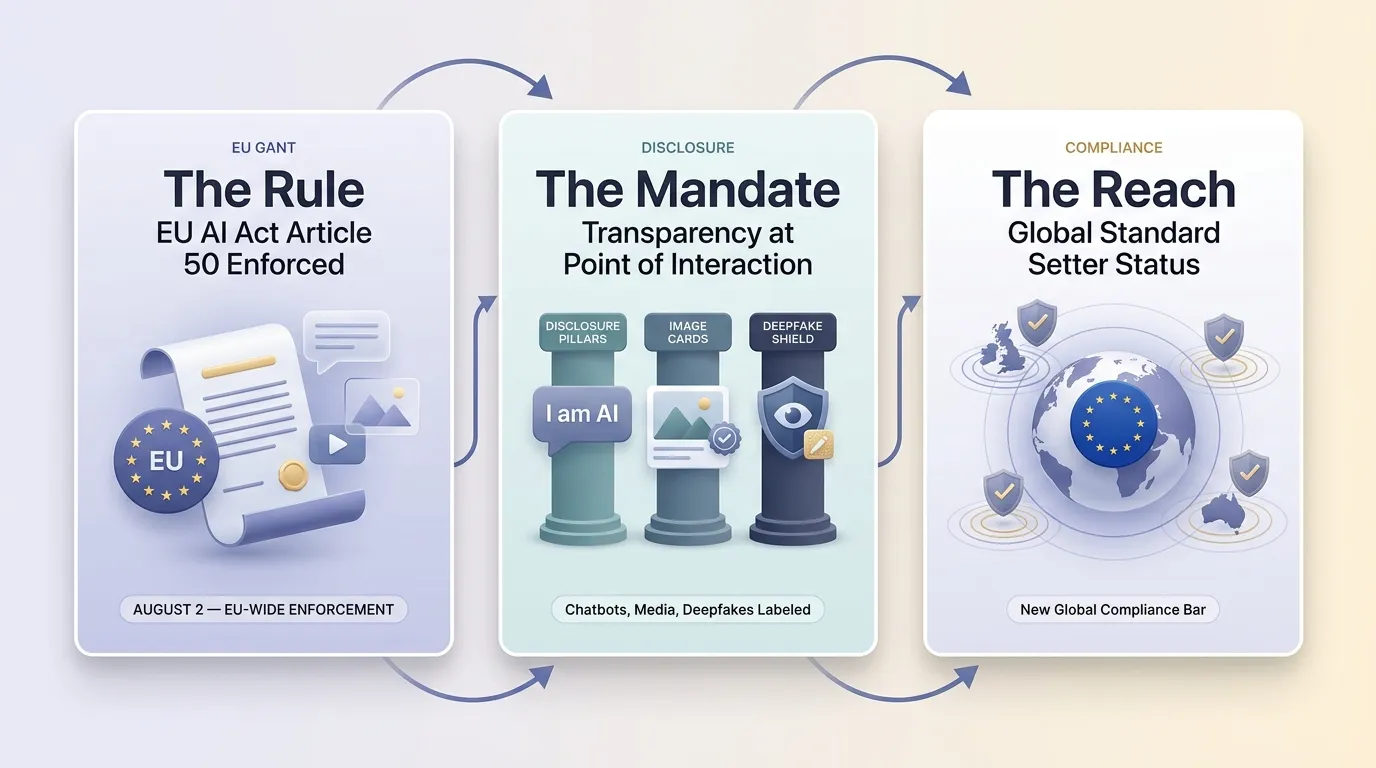
Second, AI-generated audio, video, images, and text that could be mistaken for real human output must be labeled as AI-generated. Third, deep fake content must carry explicit watermarks or disclosures in a way that is detectable by both humans and automated systems.
Companies are required to implement these disclosures at the point of interaction, not buried in terms of service. The European Commission stated it will begin enforcement actions and penalties for non-compliance immediately.
What This Means for Businesses Globally
The rules do not just affect European companies. Any organization outside the EU that serves EU users is also bound by these requirements.
That means American AI companies, Asian platforms, and global SaaS tools all have to comply or risk losing access to the European market.
For a practical walkthrough of what Article 50 means for compliance teams and developers, this video is genuinely useful:
Can You Tell If It’s AI? Article 50 Transparency Rules Explained
The EU is once again positioning itself as the global standard-setter for digital regulation. The AI Act’s transparency rules may well be adopted or referenced by regulators in the UK, Canada, and Australia over the next 12 months.
Companies that get their compliance infrastructure right now will be in a much stronger position than those scrambling to catch up when other jurisdictions follow suit.
Quick Links: