
The startup world has spent a decade celebrating team-built, VC-funded businesses. The data in June 2026 is telling a different story.
Solo work is no longer just a stop before building a team. More founders now treat it as a deliberate business model built on software, contractors, repeatable workflows, and narrow offers. Running a one-person business can give you more control, better margins, and faster decisions if you build systems first instead of hiring too early.
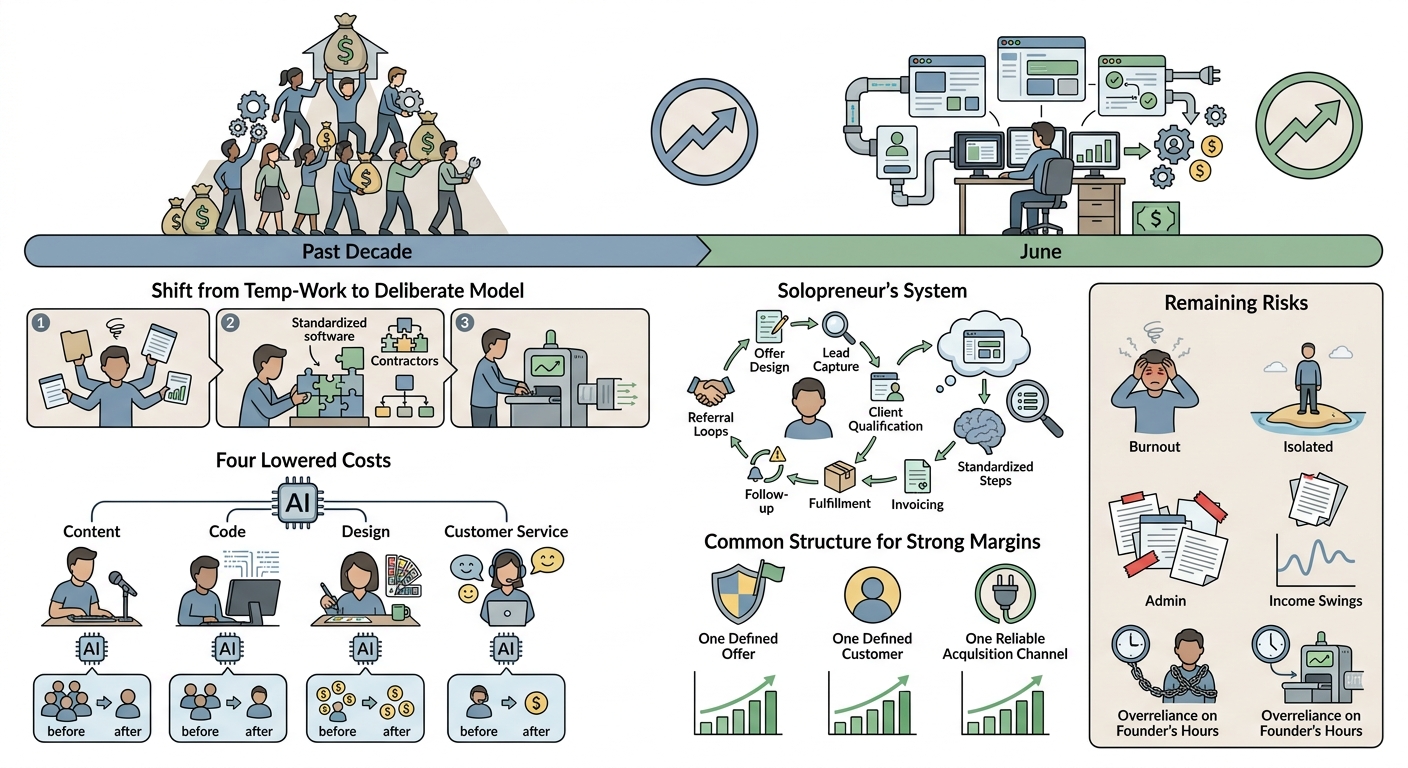
The economics behind this shift are straightforward. AI tools have dramatically lowered the cost of production across content, code, design, and customer service — the four functions that previously required hiring before a solo business could scale. A solopreneur with the right AI stack can now serve a customer base that would have required a team of five two years ago.
The winning solopreneur in 2026 is rarely the most talented generalist. It is the person with the cleanest system. That includes offer design, lead capture, client qualification, invoicing, fulfilment, follow-up, and referral loops. One-person businesses break when knowledge lives only inside the founder’s head.
The one-person businesses generating the strongest margins in 2026 share a common structure. They have one clearly defined offer serving one clearly defined customer. They have documented systems for delivery that do not depend on the founder’s continuous presence. And they have one reliable acquisition channel that generates predictable demand without constant attention.
Reddit’s r/Entrepreneur at https://www.reddit.com/r/Entrepreneur/ has a thread this week on solopreneur revenue milestones. The numbers being shared are significantly higher than what most people associate with solo businesses — multiple six-figure operations run by single founders with narrow offers and strong systems.
The Risk That Still Does Not Go Away
The biggest risks for solopreneurs remain burnout, isolation, messy admin, income swings, and overreliance on the founder’s own hours. If your income stops the second you stop working, you still have a job, not a business.
X at https://x.com/search?q=solopreneur+business+model+AI+2026 has solo founders sharing what systems they built first and which ones they wish they had built earlier. The recurring theme is that offer documentation and a reliable sales channel matter more than any individual tool or platform choice.
Quora at https://www.quora.com/Is-the-solopreneur-model-viable-in-2026-with-AI-tools has answers from successful solopreneurs on the specific systems that allow one-person businesses to generate significant revenue without scaling headcount.
Quick Links: