
Webinars are hot in 2025! Businesses are running more online events than ever before, and people are tuning in weekly to learn new things.
If you are a marketer, an educator, or a business leader, understanding the latest webinar statistics 2025 is vital for planning and getting great results.
This article dives deep into over 70 current insights about attendance, conversion rates, how people engage, registration trends, webinar length, and how different industries use them. You will find out what works right now so you can make your webinars even better.
We have gathered the newest data from reliable sources, focusing on information from this year. This guide helps you optimize your webinars, boost engagement, and make sure you see a good return on your effort and money.
Let’s explore what the 2025 numbers reveal about these quickly changing online events.
Top Webinar Statistics 2026 – Quick Insights

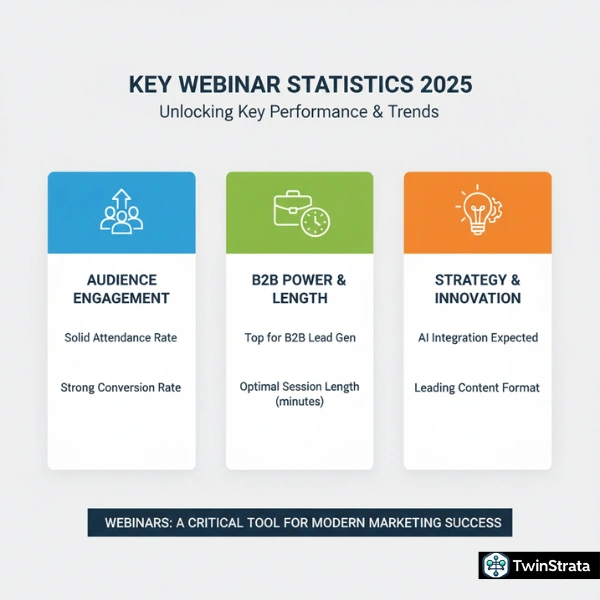
Here are some of the most important webinar statistics 2025 you should remember:
- The average webinar attendance rate usually falls between 35% and 45%.
- Webinars convert attendees into leads at an impressive average rate of 56%.
- For businesses (B2B), 73% of webinar attendees become leads.
- The best length for a webinar is often 30 to 45 minutes.
- A huge 98% of marketers plan to use AI in their webinars this year.
- Most businesses, about 85%, see webinars as a key part of their marketing plan.
- More than half (51%) of content marketers say webinars give them the best results.
- Most B2B professionals, 91%, prefer webinars over other content types.
- Over 75% of webinars have fewer than 50 people attending live.
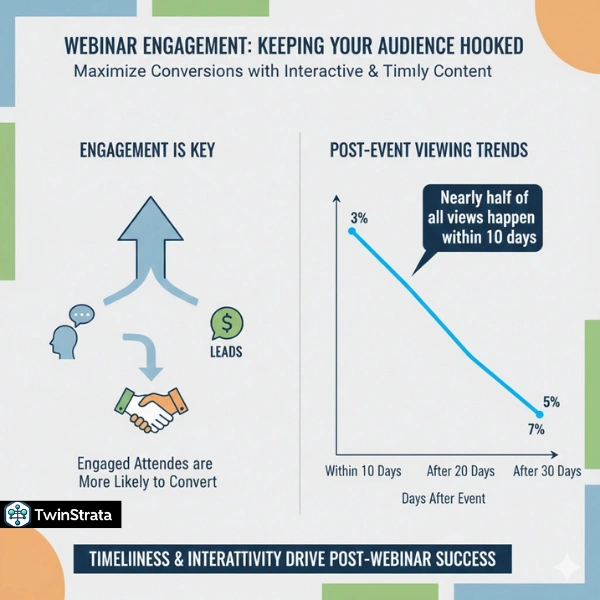
- Nearly half (47%) of webinar views happen after the live event, on-demand.
- 60-minute webinars get the most sign-ups.
- Smaller webinars, with fewer than 100 registrants, have 5% higher live attendance.
- Thursdays see 22% of all webinar registrations.
- Many people, 13%, register on the very day of the webinar.
- AI features for repurposing content save marketers over 13,000 hours and $650,000 yearly.
Also read about: EverWebinar Review
Why Webinars Are So Effective for Marketing in 2026
Today’s consumers are smart; they easily spot ads and sales pitches. This makes traditional marketing less effective. Webinars, however, offer a fresh, powerful way for businesses to connect with their audience.
People are actively looking for valuable content and solutions to their problems, and webinars perfectly fit this need.
What is a Webinar?
A webinar is an online event, usually hosted by a company or business, that broadcasts live on a specific date and time.
Most webinar tools provide a registration page where your audience can sign up, get reminders, and receive a recording afterward. During the live session, the host and any guest speakers interact with the audience using features like Q&A, polls, and chat.
Why Run Webinars in 2025?
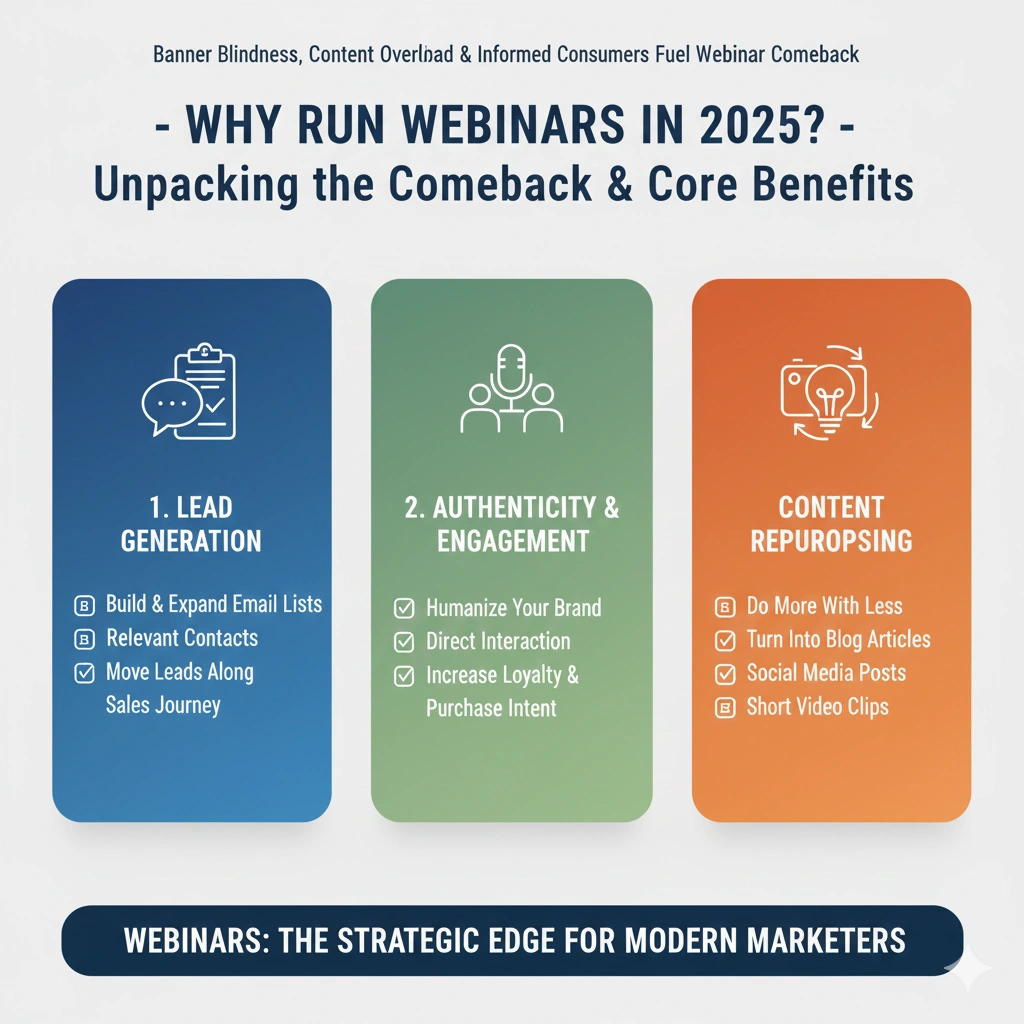
Webinars are truly making a strong comeback this year. Many reasons explain this, including “banner blindness” (people ignoring online ads), too much content, and more informed consumers. Webinars offer three main benefits:
- Lead Generation: Marketers use webinars to build and expand their email lists with relevant contacts, since these attendees are clearly interested in the topic. Webinars are powerful tools for generating leads and moving them further along the sales journey.
- Authenticity and Engagement: Live webinars give hosts and speakers a platform to share their experiences and stories, which makes the brand feel more human. Attendees can engage directly with the brand, increasing their loyalty and making them more likely to buy.
- Content Repurposing: In challenging economic times, marketers often need to “do more with less.” Webinars are a fantastic solution. You can easily turn each webinar into a blog article, several social media posts, and short video clips. This greatly boosts your content output.
Also read about: WebinarJam Coupon Codes
Are Webinars Worth It in 2026? Absolutely!
Webinars are one of the most effective content formats for businesses this year. The data clearly shows just how powerful they have become.
- B2B marketers rank webinars as the second best-performing content format. In the last year, 64% of B2B marketers hosted a webinar, placing it among the top 5 most-created content types. An impressive 47% of B2B marketers even said webinars (or virtual events/online courses) were their best-performing content.
- B2B marketers consider webinar lead quality to be “above average.” Many marketers (68%) directly link webinars to revenue. An even larger group (75%) found that webinars lowered their cost per lead. About 38% rated webinar leads as 4 or 5 out of 5 stars, with the average rating being 3.3/5.
- Professionals want “Tips, tricks, and best practices” content. When asked, 67% of professionals voted this category as “most valuable for professional growth.” Courses (53%), case studies (53%), and industry trends (50%) followed closely. This tells us attendees want actionable advice they can use right away.
General Webinar Market Insights for 2026
Let’s look at some big-picture webinar statistics 2025 about the overall market.
- The global webinar and virtual event market will reach $1 trillion by 2032. This industry is growing incredibly fast. In 2022, it was worth about $315.5 billion, and experts expect it to hit over $1 trillion in the next decade, showing a 14% yearly growth rate. This isn’t just a lingering effect from the pandemic; companies now see that virtual events work incredibly well for reaching people worldwide without huge costs.
- North America generates 77% of webinar revenue. America leads the way in the webinar market, bringing in over three-quarters of the total revenue. However, regions like Europe, Africa, and the Middle East are also growing quickly.
- 58% of B2B marketers use webinars for promotion. Webinars are very effective at turning potential customers into qualified leads, often much better than other marketing channels. When you can show your expertise, demonstrate your product, and talk directly with potential customers in one session, it is clear why webinars have become such a powerful lead-generating tool.
- Standalone webinars get 56% more registrations than webinar series. People often find it easier to sign up for a single event rather than commit to multiple sessions. Standalone webinars also create a sense of urgency, as there is no “I’ll catch the next one” option.
- More than 75% of webinars have fewer than 50 live attendees. It’s okay if your webinars don’t attract thousands of people. Smaller webinars actually tend to have higher live attendance rates and better engagement. About 69% of all webinars (live + on-demand) have under 50 views.
- 93% of webinars are delivered live. Most webinar hosts prefer live formats because they can interact directly with their audience, answer questions on the spot, and create a more engaging experience. Only about 3% of webinars are “simulive” (pre-recorded but presented as live), and 4% use short pre-recorded videos during an otherwise live session.
Also read about: Content Marketing Statistics
Webinar Registration Statistics 2026
How can you get more people to sign up for your webinars? These key data points show you how to maximize your registrations.
- People register for and watch 2 webinars on average per year. This means attendees are interested enough to come back for more than one session, making webinars an ongoing part of their learning.
- Webinar registration page conversion rates can hit 59%. High-quality webinar platforms and well-designed pages can nearly double the average conversion rate of 30% reported by some platforms. A good landing page significantly boosts sign-ups and live attendance.
- 78% of webinar registrations happen on desktop computers, but 22% come from mobile. You must ensure your registration page looks and works great on both mobile and desktop. A simple, fast, and mobile-friendly design helps keep the process smooth for everyone.
- 77% of webinar sign-ups use email. Most people prefer email for registration, likely because it is a familiar and easy option. Make sure your email fields are clear and prominent.
- 71% of webinar hosts use their platform’s built-in signup page. While many platforms offer built-in pages or integration with external forms (like HubSpot), choose a tool that integrates smoothly with your CRM to avoid manual data transfers.
- Thursday webinars see the highest average registrations. Thursdays usually have 30% more registrants. This makes sense as people are settled into their work week but not yet mentally checked out for the weekend.
- 60-minute webinars get the most sign-ups. Although 90-minute webinars have the highest live attendance, 60-minute sessions lead in registrations, followed by 45-minute and 30-minute options.
- 78% of people will avoid “salesy” or overly marketing-focused webinars. People also dislike content that is too product-focused (78%) or a poor platform experience (78%). Focus on providing value and use a modern, reliable platform.
- Email marketing is the best channel for registrations, while ads are the least effective. An external survey of B2B SaaS marketers found that while social media posts are widely used (94%), marketing emails bring in the most high-quality leads (91%). Newsletters (20%), website banners (18%), LinkedIn DMs (16%), and paid ads and communities (11%) are less effective for high-quality leads.
- Webinars with guest speakers attract more registrations. Nearly half of marketers (45%) invite guest speakers to every webinar, and 21% do so often. This brings fresh ideas, credibility, and expands your reach. Webinars with guest speakers see 3 times more engagement!
Here is a table summarizing popular registration channels:
| Platform Used to Drive Registrations | Percentage of Businesses |
| Website | 80% |
| 76% | |
| Social Media | 60% |
| Partners Channels | 51% |
| Programmatic Advertising | 49% |
| Third-Party Database | 45% |
| Sales | 39% |
- Most registrations happen close to the event. About 48% of registrations occur less than 7 days before the webinar, and 77% happen within two weeks. Only 3% register more than four weeks in advance. Even on the day of the webinar, 13% of people still register. Keep promoting your webinar right up until it goes live!
Here is a breakdown of registration timing:
| Time Frame of Registration | Percentage of Registration |
| 4 weeks before the webinar | 12% |
| Between 2 to 4 weeks of webinar | 13% |
| Between 1 to 2 weeks of webinar | 16% |
| Less than a week | 59% |
Webinar Engagement Statistics 2026
Engagement is crucial for successful webinars. These stats show you how to keep your audience hooked.
- 62% of registrants watch the webinar (live or replay). On average, nearly 6 out of 10 people who sign up for a webinar actually watch it. Smooth user experiences, automated reminders, and on-demand options all help increase viewership.
- 47% of webinar views are on-demand (replay). Many people have busy schedules and cannot attend live. Making your webinar available for replay ensures a much larger audience can access your content.
- 38% of webinars happen at 11 AM local time. This is the most common time, followed by 10 AM (18%) and 12 PM (17%). These slots often have higher live attendance rates. This is a significant increase from last year’s 17% at 11 AM.
- Wednesday and Thursday are the best days to host webinars. Thursdays host 28% of all webinars, and Wednesdays host 26%. These mid-week days account for 77% of webinar experiences and generally see the highest attendance. Mondays and Fridays are less ideal.
Here is a table showing webinar hosting by day:
| Day Of The Week | Percentage Of Hosted Webinars |
| Sunday | 1% |
| Monday | 9% |
| Tuesday | 23% |
| Wednesday | 26% |
| Thursday | 28% |
| Friday | 9% |
| Saturday | 4% |
- 44% of webinars use live polls. Polls are an excellent way to interact with your audience, and their use has increased by 14% from last year. The average number of poll responses is 24, indicating engaged attendees. The best webinars run about two polls in an hour-long session, achieving a 52% completion rate.
- 92% of webinar attendees say a live Q&A session is a must. Audiences want to engage, ask questions, and get real-time answers. This shows a shift from passive viewing to active participation. Q&A sessions allow attendees to provide feedback, clear doubts, and interact directly with experts.
- 69% of webinars offer downloadable resources for attendees. Two-way engagement is a key benefit of webinars. Providing downloadable resources (like slides or guides) alongside Q&A sessions (81% use this), surveys (36%), social features (25%), and group chat (10%) helps keep the audience engaged.
Here is a breakdown of engagement content:
| Content Utilized To Create Engagement | Percentage Of Marketers |
| Q&A | 81% |
| Resources for download | 69% |
| Surveys | 36% |
| Social | 25% |
| Polling | 22% |
| Group chat | 10% |
Webinar Attendance Rates 2026
Boosting your webinar attendance is a direct way to improve your ROI. These stats show you how.
- Webinar attendance rates generally fall between 35% and 45%. You can significantly increase this by offering incentives, sending reminder emails, and choosing optimal hosting times. These strategies can boost participation by up to 20%.
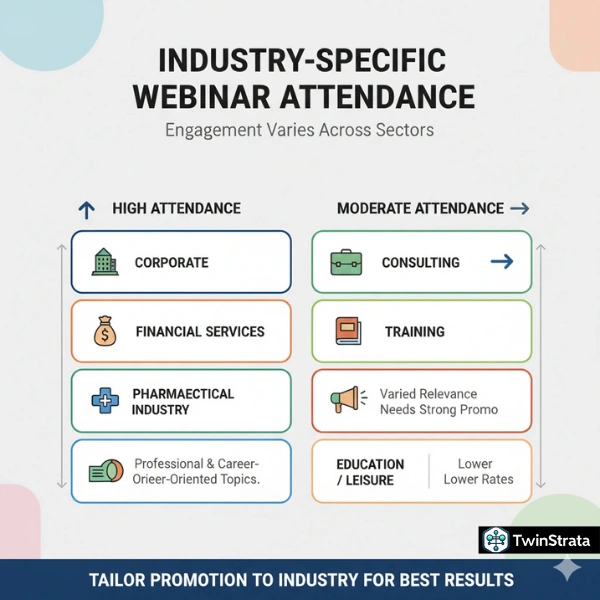
- Corporate webinars attract 65% attendance, while training webinars see 45%. Marketing webinars typically have lower attendance (44%). Industry-specific attendance rates vary:
| Industry | Average Attendance Rate |
| Financial Services | 61% |
| Pharmaceutical Industry | 61% |
| Corporate Webinars | 65% |
| Consulting | 50% |
| Training | 45% |
| Marketing Webinars | 44% |
| Education | 31% |
| Leisure/Hobby | 15% |
- Wednesdays have the highest live attendance rates (48%). Thursdays and Tuesdays follow closely with 45% live attendance. If you want more people to attend live, Wednesday is your best bet.
- Webinars at 2 PM have the highest average attendance rates (55%). This timing works well globally; 2 PM CET translates to 8 AM EST for American audiences, while 11 AM EST webinars work for Europeans at 5 PM CET. Smart scheduling maximizes participation across time zones.
- January is the month with the highest average live attendance rate (50%). Many companies start the new year with webinars, aligning with people’s professional development goals and motivation to learn. February (48%) and October (47%) also see high attendance.
- 90-minute webinars have 29% higher live attendance rates than 30-minute webinars. Longer webinars (90 minutes) achieve 72% attendance, followed by 45-minute (47%), 60-minute (46%), and 30-minute (43%) sessions. This suggests that people who commit to longer sessions are often more genuinely interested.
- Smaller webinars (under 100 registrants) have 5% higher live attendance rates. These more targeted webinars often lead to better engagement and 10% more total views. Running more, smaller webinars can be a great strategy. Webinars with 1000+ registrants have the lowest attendance at 41%.
- 82% of attendees watch webinars on desktop, 18% on mobile. While desktop remains dominant, optimizing your webinar platform for mobile is crucial, as nearly 1 in 5 viewers use their phones.
Webinar Conversion Rates 2026
Converting attendees into leads or customers is a primary goal. Here is what the numbers say about conversion rates.
- The average webinar conversion rate is 56%. Live webinars typically convert at around 33%, while on-demand webinars see a slightly lower rate of about 25%.
- Webinars with fewer than 200 attendees have the highest conversion rates. The smaller the audience, the higher the conversion. Webinars with 100 to 199 attendees average a 50% conversion rate. This drops significantly with larger audiences:
| Number of Attendees | Conversion Rate |
| 100 to 199 | 50% |
| 200 to 299 | 19% |
| 300 to 499 | 15% |
| 500 to 599 | 10% |
| 1,000+ | 6% |
Webinar Length Statistics 2025
How long should your webinar be to keep people engaged?
- 44% of webinar attendees prefer a 45-minute webinar. This is often considered the ideal length. Another 41% prefer even shorter, 30-minute sessions, while only 10% want 60-minute webinars.
- The average webinar is around 60 minutes long. This length gives presenters enough time to cover material without overwhelming the audience and allows for interactive segments. A typical 60-minute webinar might include 5-7 minutes for welcome/introductions, 38-45 minutes for the core topic, and 10-15 minutes for Q&A.
- Attendees only watch 42 minutes of a 60-minute webinar on average. The average viewing time for all webinars is 57 minutes, but attention spans often max out around 45 minutes. Schedule accordingly!
Here is a table showing average attendance length:
| Webinar Length | Average Attendance Length |
| 20 minutes | 14 minutes |
| 40 minutes | 28 minutes |
| 50 minutes | 35 minutes |
| 60 minutes | 42 minutes |
| 70 minutes | 49 minutes |
| 80 minutes | 56 minutes |
| 100 minutes | 64 minutes |
| 120 minutes | 73 minutes |
| 140 minutes | 89 minutes |
| 160 minutes | 96 minutes |
| 180 minutes | 111 minutes |
And here is a look at the popularity of different webinar lengths:
| Webinar Length | Popularity |
| 30 minutes | 8% |
| 45 minutes | 5% |
| 60 minutes | 67% |
| 75 minutes | 1% |
| 90 minutes | 11% |
| 120 minutes | 6% |
| 180 minutes | 2% |
Webinar Effectiveness and ROI in 2026
Webinars are clearly effective for achieving marketing goals.
- 85% of marketers consider webinars a vital part of their strategy. They offer a unique way to engage with potential leads in real-time, building trust and showcasing expertise.
- 73% of B2B marketers and sales leaders find webinars most effective for generating high-quality leads. Many (57%) plan to host more webinars this year.
- 99% of marketers believe webinars are a critical marketing plan element. They help generate prioritized leads, lower cost-per-lead (78%), and directly impact pipeline and revenue (72%).
- The software and technology industry organizes 29% of all webinars. Financial services follow with 14%. Non-profits host only 1%, often for awareness rather than marketing.
Here is a table detailing webinar hosting by industry:
| Industry | Share Of Webinars Hosted |
| Software and Technology | 29% |
| Financial Services | 14% |
| Education | 11% |
| Consulting | 10% |
| Government | 7% |
| Healthcare | 7% |
| Insurance | 4% |
| Manufacturing | 4% |
| Retail | 4% |
| Real Estate | 3% |
| Hospitality, Tourism, Travel | 3% |
| PR, Advertising, Marketing | 3% |
| Non-Profit | 1% |
- 51% of marketers measure webinar success through lead quality. Lead quality is a crucial metric, with 16% measuring pipeline conversion rates and 12% tracking lead volumes.
- 61% of B2B businesses use webinars as a content marketing tactic. Webinars rank as the 10th most popular content type, just below infographics (62%) and above microsites (47%). Social media content (92%) remains the most used.
- Educational sessions generate 53% more ROI than product demo webinars. While thought leadership webinars are popular (85% of marketers use them), educational content that provides actionable knowledge consistently outperforms sales-focused presentations.
- Customer story webinars rank second in ROI effectiveness. Despite being less common (only 18% of marketers run them), these webinars show your product in action through real-world examples, building trust and driving conversions.
- 35% of marketers struggle to prove ROI to stakeholders. This often happens because webinar data is not fully integrated with CRM systems. Without this connection, showing real pipeline impact becomes difficult.
- 39% of marketers track leads as their primary webinar metric. While leads are easy to measure, only 17% track pipeline influence and 12% measure actual revenue impact. This gap highlights why proving ROI can be a challenge.
Webinar Marketing Statistics 2026
Effective promotion is key to getting people to your webinars.
- Marketers host a webinar every 19 days. This consistent rhythm keeps audiences engaged without overwhelming them.
- Thursdays see the most registrations (22%). Tuesdays (19%) and Wednesdays (18%) also perform well. These are the best days to send your webinar invitations.
- Market your webinar between 9 AM and 5 PM local times. Most registrations (75%) happen during these hours, with peaks between 9-11 AM (33%) and 2-4 PM (21%).
- Half of all marketers start webinar promotion more than 4 weeks in advance. Another 48% begin 2-3 weeks prior. Only 2% wait until the last week. Early promotion is essential for building awareness.
- 57% of webinar hosts use UTM parameters to track marketing campaigns. This helps marketers understand which channels and content drive the most registrations and high-quality attendees.
- Only 17% of marketers still use “webinar” in their event titles. Most (83%) use more engaging terms like “masterclass,” “workshop,” “live training,” or “virtual event” to sound more valuable and interactive.
- 90% of marketers apply custom branding to their webinars. Consistent branding with logos, colors, and templates creates a professional impression and reinforces brand recognition, especially since webinars are often a prospect’s first interaction.
- 75% of marketers integrate webinar data with their CRM. This is crucial for maximizing data use, often through integrations with HubSpot, Salesforce, or automation tools like Zapier.
- Webinar hosts send an average of 2 reminder emails. Top performers who use a three-step reminder sequence (day before, 1 hour before, 5 minutes before) see 27% higher live attendance. Always include a calendar invite link!
Webinar Costs
Understanding costs helps you calculate your ROI.
- Hosting a webinar can cost anywhere from $0 to $5000+. Many basic platforms offer free plans if you use existing equipment (like a laptop camera). Costs increase if you hire guest speakers, use paid marketing, or invest in professional equipment.
- 93% of webinars use a regular laptop webcam. As laptop cameras improve, businesses can create professional webinars without expensive gear. 6% use smartphones, and only 1% use professional camera setups.
- The average cost per lead for webinars is $72. This can range from $45 to $98. Compared to paid ads or physical events, webinars offer a cost-effective way to generate high-quality leads, especially when you consider the long-term value and repurposing potential.
Webinar Repurposing Statistics
Repurposing webinar content is a major trend, saving marketers huge amounts of time and effort.
- 87% of B2B marketers use AI for their webinars and virtual events. Generative AI has transformed content creation from virtual events. One webinar can now become weeks of content across multiple channels without manual transcription, writing, or editing.
- Engagement with AI-generated written content increased by more than 7X. AI is driving real results! B2B marketers using AI are 7 times more likely to hit their goals, and audience engagement with AI-generated content has jumped dramatically.
- Marketers save 13,000 hours and $650,000 yearly using AI to repurpose webinars. In one platform, AI Repurpose was used over 5,300 times across 3,600+ webinars to automatically create blog posts, articles, and campaign materials from transcripts. This means marketers redirect time to strategy rather than manual content creation.
- Each webinar can create 5 short clips on average. AI can analyze webinars to find 4-5 “viral” moments – personal stories, key numbers, or anecdotes. These clips are easy to create and share across social media, emails, and landing pages, extending your content’s life and reach long after the live event.
What Users Are Asking on Quora and Reddit (Latest Trends)
Beyond the hard numbers, people on platforms like Quora and Reddit are looking for practical advice and deeper insights into maximizing webinars. Here are some common themes:
- “How do I actually get people to Many users struggle with low attendance despite high registrations. This points to the need for effective reminder strategies, compelling value propositions, and possibly shorter, more digestible content to fit busy schedules.
- “What are the best free or low-cost webinar platforms for a small business?” Budget constraints are a recurring concern, indicating a demand for accessible tools that still offer essential features like good registration pages and engagement tools.
- “How can I make my webinar more interactive than just a talking head?” This question highlights the desire for dynamic, engaging sessions. People are asking for ideas beyond simple Q&A, like advanced polling, breakout rooms, or gamification.
- “Is it better to pre-record parts of my webinar, or keep it 100% live?” Users are curious about “simulive” or hybrid formats to balance polish with live interaction, especially for consistency and managing potential technical glitches.
- “How do I repurpose my webinar content effectively across different channels?” With the rise of AI, marketers are actively seeking strategies and tools to maximize the lifespan and reach of their webinar content beyond the initial broadcast. They want to know how to turn one webinar into multiple pieces of content.
- “What’s the optimal number of speakers for a webinar to keep it engaging?” Many ponder the dynamics of single speaker vs. panel discussions, seeking advice on maintaining audience interest without overwhelming them.
These questions reinforce the need for comprehensive webinar strategies that go beyond just hosting, focusing on pre-event promotion, in-event engagement, and post-event content leverage.
FAQs About Webinar Statistics
1. What is the average attendance rate for webinars in 2025?
The average attendance rate for webinars in 2025 typically falls between 35% and 45%, but this can vary significantly based on the industry, topic, and promotional strategies used.
2. How long should a webinar be to maximize audience engagement?
To maximize audience engagement, the ideal length for a webinar is usually 30 to 45 minutes, with attendees on average watching about 42 minutes of a 60-minute session.
3. What role does AI play in webinars in 2025?
AI plays a significant role in webinars in 2025, with 98% of marketers planning to integrate it for various purposes, including content repurposing, which saves thousands of hours and significantly boosts engagement with derived content.
4. What are the best days and times to host and promote a webinar for optimal attendance?
The best days to host a webinar are Wednesday and Thursday, with Thursdays also seeing the most registrations; for optimal attendance, scheduling your webinar around 2 PM local time often yields the highest rates.
5. How important is content repurposing for webinars, and what are its benefits?
Content repurposing is incredibly important for webinars, as it allows marketers to transform one live event into multiple content assets like blog posts, social media clips, and newsletters, significantly extending the content’s reach, saving time, and increasing overall ROI.
Also Read:
- Smartphone Usage Statistics
- Google Ads Statistics
- Telegram Statistics
- Content Marketing Statistics
- AI Trends Statistics
Conclusion: Webinars in 2025 are Evolving
Webinars in 2025 remain a powerful tool for businesses across all industries. They offer high conversion rates (average 56%) and solid attendance (35-45%). Most marketers (85%) find them essential, and nearly all (98%) plan to use AI to enhance their strategy.
The sweet spot for webinar length is 30-45 minutes, and most people register less than a week before the event.
These numbers clearly show that webinars are not fading; they are becoming more sophisticated and effective. Use this data to rethink your webinar format, boost engagement through interactive features, and align your content with what your audience truly wants.
By understanding these webinar statistics 2025, you can host smarter, more impactful webinars today!
Source: WebinarNinja, LiveWebinar