
China has pushed back against claims that its AI firms secretly copy foreign models, just as a powerful new Chinese system shook the industry.
The denial came days after Moonshot AI launched Kimi K3, a 2.8 trillion-parameter model that rivals the best from Anthropic and OpenAI at a fraction of the cost. The clash has reignited a long-running fight between Washington and Beijing over AI technology. Here’s what both sides are saying.
A Recurring Dispute
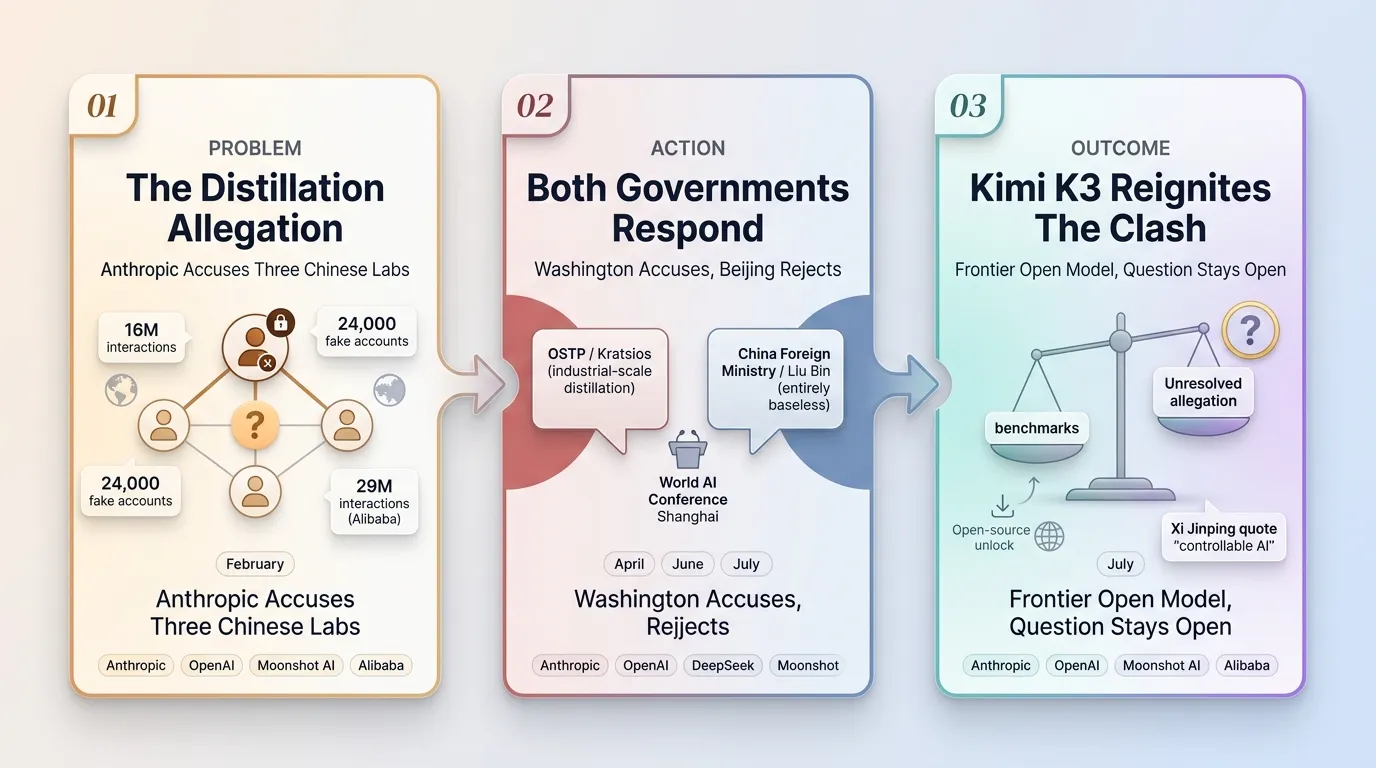
At the center of the argument is a technique called distillation. It uses an older, stronger “teacher” model to train a newer “student” model, which can copy its abilities at a much lower cost.
The controversy began in February 2026, when Anthropic accused three Chinese labs, DeepSeek, Moonshot AI, and MiniMax, of using its Claude model without permission.
Here’s how the claims have stacked up:
February: Anthropic alleged the labs generated over 16 million interactions through around 24,000 fake accounts
Anthropic said the labs targeted Claude’s most valued skills: agentic reasoning, tool use, and coding
Around the same time: OpenAI made similar claims against DeepSeek
June: Anthropic named Alibaba in what it called the largest distillation operation against Claude, with nearly 29 million interactions
Anthropic has been careful to note that distillation itself is a widely used and legitimate training method. Its objection is to the alleged use of fake accounts to bypass restrictions, which it says violates its terms of service.
The Dispute Reaches Governments
This is no longer just a corporate spat. In April, the White House Office of Science and Technology Policy released a memo accusing China of “industrial-scale” distillation.
“The US has evidence that foreign entities, primarily in China, are running industrial-scale distillation campaigns to steal American AI,” said OSTP Director Michael Kratsios.
China rejected that firmly. Its Foreign Ministry called the accusations “entirely baseless” and “a slanderous smear against the achievements of China’s artificial intelligence industry.”
The latest denial came at the World AI Conference in Shanghai. “Some countries hype up distillation,” Assistant Foreign Minister Liu Bin told attendees, without naming the US directly. “This is misguided and counterproductive.”
Kimi K3 Reignites The Debate
The timing put fresh heat on the issue. Moonshot plans to release Kimi K3’s full weights by July 27, making the world’s largest open-weight model free to download.
At $15 per million output tokens, it costs less than a third of comparable Anthropic pricing. Early benchmarks placed it ahead of Claude Opus 4.8 and competitive with Fable 5.
A few points keep the debate open:
The performance is real, but the distillation claim remains an allegation, not proven fact
Some testers noted K3 sometimes identified itself as Claude, which critics see as a red flag, though that alone is not proof
None of the accused firms have publicly addressed the specific allegations
At the same conference, President Xi Jinping called for AI to remain “controllable” by humans and urged international cooperation.
For now, the facts on the ground are clear: China has a frontier-class open model, it costs far less than Western options, and the question of how it was built remains disputed on both sides.
Quick Links: